
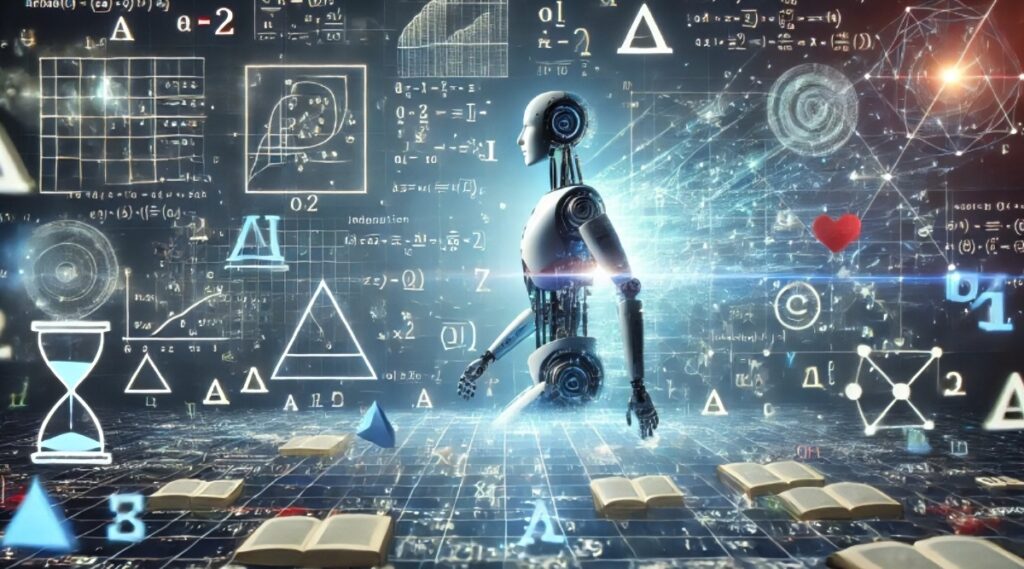
AI is ubiquitous — with few people even realizing. Your phone, your mailbox, your music app. It’s all simultaneously calculated in the background by equations, probabilities, and algorithms. Artificial intelligence isn’t magic. It’s mathematics at speed and on a large scale.
How Math Became the Engine of Modern AI
Behind every smart system is a set of mathematical rules. Linear algebra powers image recognition. Calculus optimizes neural networks through a process called backpropagation. Probability theory drives the predictions your apps make every single day. AI by math isn’t a new concept — it stretches back to Alan Turing — but the computing power to run it at scale only arrived recently.
The AI Index at Stanford is up to 2022, revealing that the uptake of AI in businesses has doubled over the last five years. This expansion wasn’t due to philosophy.
Spam Filters and Email Sorting
Open your inbox. The reason junk mail lands in the junk folder — and not on your screen — is Bayesian probability. The algorithm calculates how likely a message is to be spam based on prior examples. Words, sender patterns, link structures. Each one shifts the probability score.
More than 100 million spam emails are blocked by Gmail per day in this way. It’s a small thing. But it’s a wonderful occasion of math-based AI doing invisible, useful work.
Recommendation Systems You Use Every Day
Netflix, Spotify and YouTube are examples of companies that utilize collaborative filtering. The technique involves comparing your behavior with millions of others and discovering patterns via a linear algebra operation called matrix factorization. The system seems to have no idea of your preferences. It is able to tell your numbers.
Navigation Apps and Real-Time Prediction
Google Maps doesn’t just show you roads. It predicts travel time, reroutes around accidents, and estimates arrival windows — in real time. The math here is graph theory combined with machine learning trained on historical traffic patterns.
Every time you tap “Go,” you’re triggering shortest-path algorithms like Dijkstra’s, adjusted dynamically by AI models. Over a billion kilometers are navigated through Google Maps each day. That’s an enormous amount of math happening per second.
Solving Problems, One Equation at a Time
AI has also made a direct impact in the field of education. Optical Character Recognition and symbolic computation enable math solvers to understand handwritten or typed equations and provide step-by-step solutions. In the realm of AI in math, the idea isn’t to let AI do everything. The idea behind using AI for math is not to let it do everything, but to save time on repetitive tasks or to gain knowledge. Math AI can help find alternative approaches to problem solving, verify results, or help review topics by repetition.
Face Recognition on Your Phone
Unlocking your phone with your face involves geometry, statistics, and neural networks simultaneously. The camera maps dozens of facial landmarks, converts them into a numerical vector, and compares that vector against a stored model. If the distance between vectors falls below a threshold — you’re in.
Apple’s Face ID claims a one-in-a-million false acceptance rate. That precision is purely mathematical. No intuition, no vision — just vectors and thresholds doing their job