
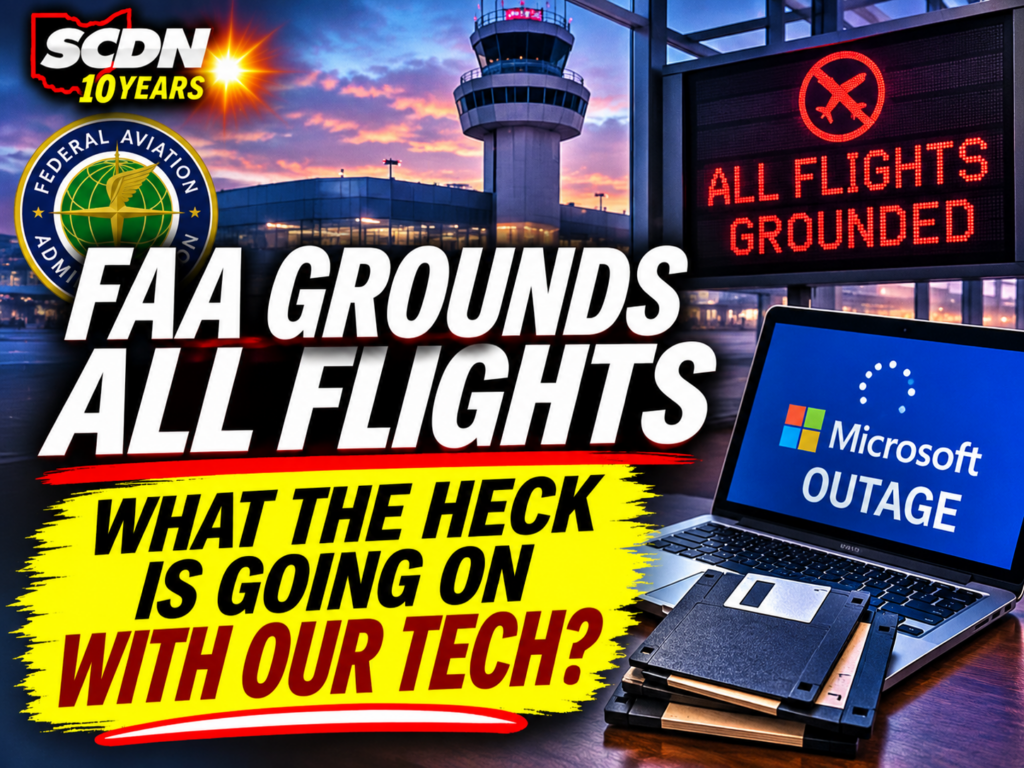
If Friday’s nationwide flight shutdown has you wondering what the heck is going on with the technology holding modern life together, you’re probably not alone.
The Federal Aviation Administration ordered a nationwide ground stop Friday afternoon, halting departing flights across the United States after communications problems affected the country’s air traffic control system.
The FAA cited “extraordinary circumstances” and safety concerns as it ordered departing aircraft to stay on the ground. Transportation Secretary Sean Duffy said technicians were investigating communications problems affecting air traffic control centers.
That would be unsettling enough on its own.
But it happened while businesses, governments and ordinary computer users around the world were still dealing with a massive Microsoft outage that knocked out or disrupted Outlook, Teams, Copilot and other Microsoft 365 services for more than a day.
Microsoft says that outage was caused by server problems and has specifically said it found no known malicious activity behind it. The company also ruled out AI as the cause.
So, to be clear:
There is currently no evidence that the Microsoft outage and the FAA communications failure are connected.
There is also no public indication at this point that the FAA problem was a cyberattack.
But when two enormously important technology systems stumble at almost the same time, it raises a pretty reasonable question:
Just how fragile is the digital infrastructure we depend on every day?
When Everything Depends on Everything Else
Microsoft’s outage was not just an inconvenience for somebody trying to check email.
It disrupted communications at banks, healthcare organizations, government agencies, shipping companies and other businesses around the world.
Some companies reportedly fell back on old-school backup plans including telephone calls and even fax machines.
That is the uncomfortable thing about modern infrastructure.
Hospitals, banks, airlines, governments and businesses may appear to be completely separate systems, but many of them depend on a relatively small number of technology providers, communications networks and cloud platforms.
When one piece fails, the problem can spread far beyond the computer that actually broke.
And aviation has its own aging-technology problem.
Yes, The FAA Was Still Using Floppy Disks
Here’s the detail that sounds like a joke but isn’t.
Just eight days before Friday’s nationwide flight stoppage, the FAA announced it had begun replacing systems that still relied on floppy disks.
Not USB drives.
Not cloud storage.
Floppy disks.
The Transportation Department announced Nov. 5 that a new Enterprise Information Display System would replace four systems dating back to the 1980s at more than 400 FAA facilities.
Those older systems used floppy disks to distribute information including weather data, flight alerts, restricted airspace schedules and pilot reports.
The FAA says the replacement system is being installed at 435 sites and is expected to be completed by the end of 2028.
Transportation Secretary Sean Duffy summed up the modernization announcement rather cheerfully:
“Floppy disks are out, 21st century tech is in.”
That line sounds a little different eight days later.
This Isn’t the First Warning
Friday’s nationwide grounding was extraordinarily unusual.
The last nationwide FAA ground stop caused by a system failure came in January 2023, when the agency’s NOTAM system went down. That system distributes critical safety information pilots are required to review before flying.
Friday’s shutdown again brought the condition of the nation’s air traffic technology into the spotlight.
Congress approved billions of dollars toward modernization last year, including plans to replace old copper wiring with fiber-optic connections and update communications equipment, but the FAA says much more work remains.
And that is really the bigger issue.
The danger does not have to come from some shadowy hacker sitting in a dark room.
Sometimes a server fails.
Sometimes communications equipment fails.
Sometimes software fails.
Sometimes somebody makes a bad update.
And sometimes an enormously important government system is still depending on technology designed when people were renting movies on VHS.
Cybersecurity Isn’t Just About Hackers
When people hear the word cybersecurity, they tend to think about ransomware, foreign governments and criminals stealing passwords.
Those threats are very real.
But protecting critical infrastructure is also about resilience.
Can a system keep operating when part of it fails?
Is there a backup?
Is the backup actually tested?
Can people communicate without the primary network?
Can one failure take down an entire organization — or an entire country’s flight departures?
Those are cybersecurity and infrastructure questions even when nobody hacked anything.
The Microsoft outage offered one example of just how dependent businesses have become on a handful of technology platforms.
The FAA shutdown offered another reminder that some of America’s most important systems are still undergoing badly needed modernization.
Again, there is currently no evidence the two events are related.
Maybe Friday was simply an astonishingly bad day for technology.
But after a worldwide Microsoft outage, a nationwide FAA ground stop and an announcement that air traffic controllers are finally being liberated from floppy disks, asking “What the heck is going on?” seems perfectly reasonable.
And perhaps the better question is:
How much of the technology holding modern America together are we just assuming will work tomorrow because it worked yesterday?