
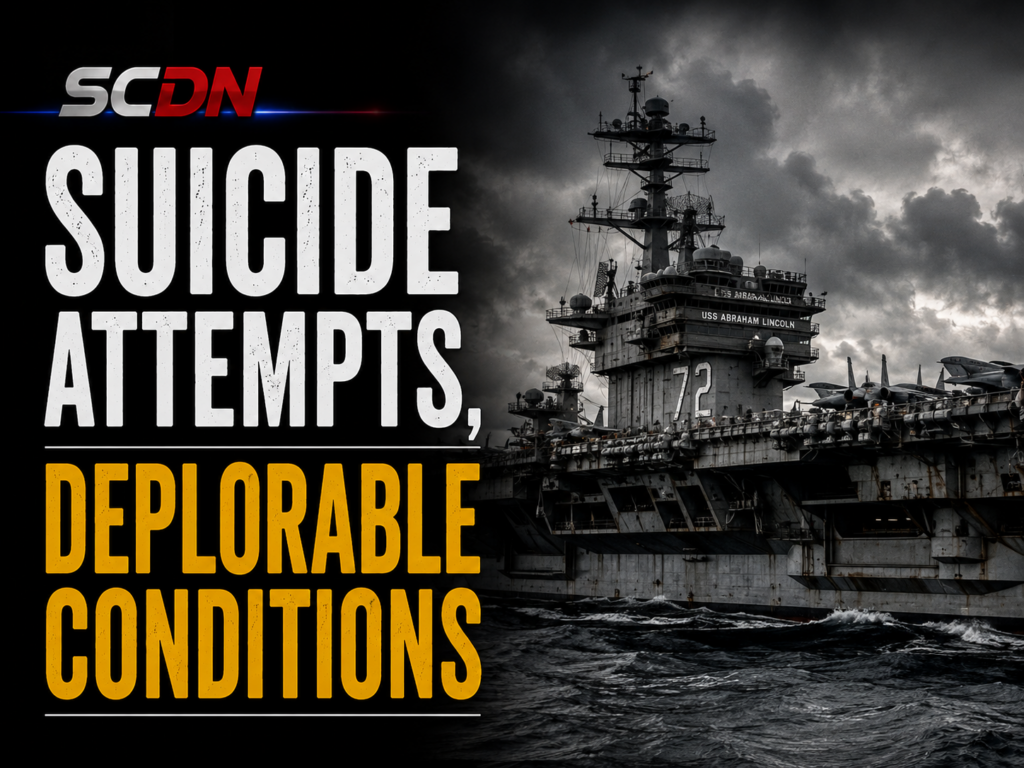
Families of sailors and Marines aboard the USS Abraham Lincoln are sounding an increasingly urgent alarm over mental health, exhaustion and living conditions as the aircraft carrier approaches nine months away from its San Diego homeport.
The concerns became public during an emotional meeting with Navy leadership at Naval Air Station North Island, where roughly 200 family members confronted Acting Secretary of the Navy Hung Cao and other senior officials about conditions aboard the carrier and uncertainty over when their loved ones will finally come home.
One spouse told officials her husband had sent a message saying he hoped he would not wake up the next morning. Another parent said her daughter had begun to believe she might never return home.
Those are not complaints about missing a vacation.
They are warning signs.
The Lincoln left San Diego on Nov. 21, 2025, originally bound for an Indo-Pacific deployment. The carrier was later redirected to the Middle East and has spent months supporting combat operations connected to Operation Epic Fury and the conflict with Iran. Its deployment, originally expected to end months ago, has repeatedly been extended.
Before a brief stop in Oman in July, the carrier spent more than 200 consecutive days at sea, breaking the modern-era carrier record set during the COVID-19 period. About 5,000 sailors and Marines are embarked aboard the ship.
Families say the strain is showing.
Stars and Stripes reported last month that one sailor sent relatives a message warning that the crew’s mental and physical health was in danger and adding simply: “We need help.”
A relative described being unable to do anything from home as both worrisome and heartbreaking.
More recent reports have raised even more serious concerns.
Navy Times reporting, cited by The Guardian, described separate incidents in which sailors reportedly attempted to go overboard or were stopped by fellow crew members. Annabelle Loma told the publication that her husband had attempted to jump from the ship after becoming burned out during the extended deployment. She said he now fears the incident could destroy a 13-year Navy career. Another sailor reportedly grabbed a crew member during a separate incident and prevented that person from going overboard.
The Navy has not publicly confirmed a number of suicide attempts aboard the carrier and disputes suggestions that such incidents have increased.
A Navy official told The Guardian that available information had not shown an increase in reported suicidal thoughts or suicide attempts aboard the USS Abraham Lincoln The service said sailors have access to medical personnel, chaplains and deployment-resilience counselors.
That official response does not erase the messages families say they are receiving from the ship.
It creates two very different pictures of the same deployment.
Toilets, Showers, Laundry and Food
Mental health is only one part of the complaints.
Families have reported broken toilets, showers affected by mildew or mold, laundry facilities unavailable for extended periods, stretches without hot water and difficulty obtaining basic personal supplies. Rep. Mike Levin of California publicly described reports of meals as small as half a cup of rice and two tortillas while also citing shortages of soap, deodorant and toothpaste.
During the family meeting, Navy officials acknowledged that a persistent clog had disabled toilets in one section of the carrier for an extended period. Officials said what sailors described as mold in some shower areas could instead be mildew related to poor ventilation. Families also raised concerns about water quality, food supplies and disrupted mail service.
The Navy strongly disputes claims that the USS Abraham Lincoln sailors have been left without adequate food.
Chief of Naval Operations Adm. Daryl Caudle said in April that ships in the Lincoln strike group had at least 10 days of food aboard, with some carrying supplies for 30 days or longer. He said meals were meeting Navy nutritional requirements and rejected reports of a food shortage.
The distinction may be between whether enough food exists aboard the ship and what individual sailors are actually receiving at particular meals.
Families previously supplied photographs they said showed unusually small portions. Navy officials challenged some of those photographs, saying they were taken at a shore facility rather than aboard a Navy ship.
Science Backs Up the Stress
The larger concern about prolonged life at sea is not based only on family anecdotes.
A 2025 study published in Military Medicine surveyed 441 active-duty Navy sailors with recent experience underway. Researchers found the most serious shipboard stressors included loud noise, inability to rest when needed, inadequate access to quality mental and physical health care and insufficient personnel to accomplish the mission.
Nearly half — 48.3% — said programs and services available to help sailors deal with stress at sea were inadequate. Researchers specifically recommended better sleeping conditions, improved access to health care and efforts to reduce the stigma surrounding sailors who seek mental health treatment.
Those findings become harder to dismiss when a deployment measured in months keeps getting longer.
Lincoln Is Not the Only Carrier With Problems
Recent problems aboard the USS Gerald R. Ford have also brought attention to what sailors endure during unusually long carrier deployments.
The Ford returned home in May after 326 days deployed — the longest post-Vietnam carrier deployment at that point. During the deployment, a March fire in the ship’s main laundry spaces injured three sailors, displaced hundreds from sleeping areas and disrupted laundry operations. Nearly 200 sailors were treated for smoke-related problems.
The $13 billion carrier has also experienced repeated problems with its vacuum sewage system serving roughly 650 toilets. Navy leaders have argued the extent of those problems was exaggerated, while a previous Government Accountability Office review found design concerns with the system. The Ford is now undergoing scheduled maintenance that includes work on its sewage system.
The situations aboard the Ford and Lincoln are not identical, but together they raise questions about what happens to sailors when deployments stretch far beyond the ordinary and maintenance, logistics and human endurance are all tested at once.
Families Still Waiting
Navy leaders told USS Abraham Lincoln families that the USS Theodore Roosevelt strike group is being prepared to eventually relieve the carrier.
They would not provide a return date, citing operational security.
That leaves spouses raising children alone, families missing births and funerals, and sailors aboard the carrier wondering when the deployment will finally end.
One spouse at the San Diego meeting said her husband has had virtually no time with their new baby. Other sailors have children they have never met.
The Navy says it recognizes the strain.
Vice Adm. Joseph Cahill told the families that leadership understands the impact extended operations are having on both sailors and those waiting at home. Navy officials maintain that mental health services, clean water, air conditioning and healthy meals remain available aboard the carrier.
For the families, however, the issue has moved beyond whether an aircraft carrier remains capable of launching planes and completing its combat mission.
They want to know what condition their sailors will be in when the ship finally comes home.