
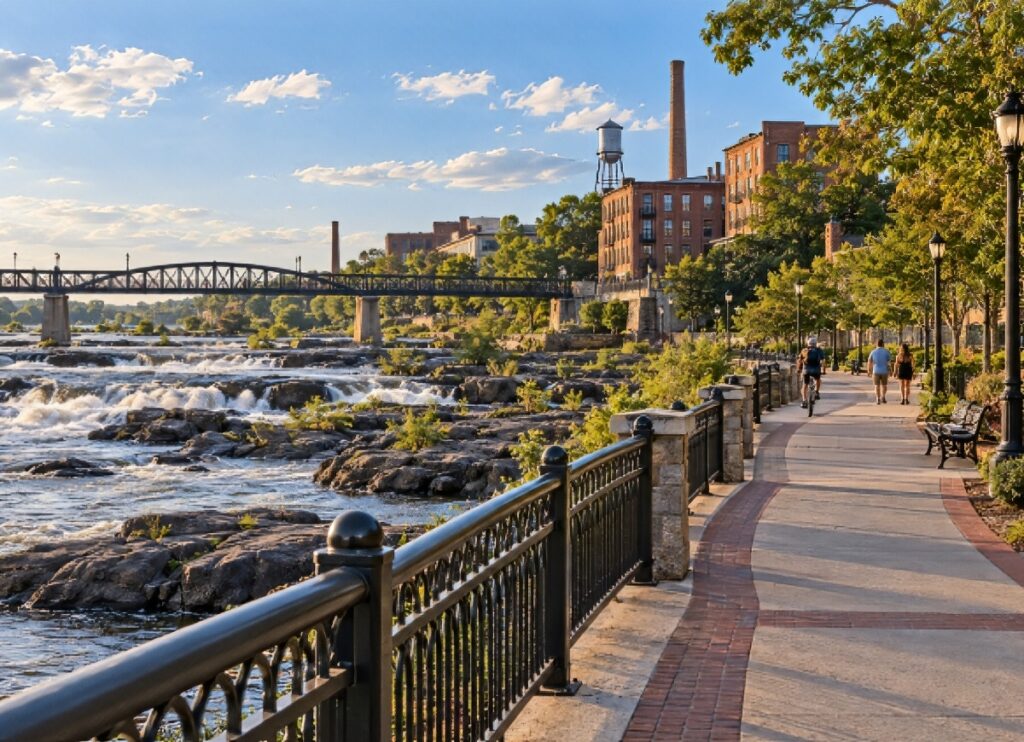
The final phase of Riverfront Place alone brought more than $250 million in investment to Uptown Columbus, according to W.C. Bradley. It’s a multi-family community with a parking structure and 40,000 square feet of street-level retail along Front Ave. That number matters for more than civic pride. It shows developers now treat the riverbank as a serious real estate asset, not just scenery.
The project has already proven that point once. The Currents at Riverfront Place won a 2025 CoStar Impact Award, judged by real estate professionals who track local market performance. An award doesn’t set home prices on its own, but it shows the market already sees the riverfront as more than a view. Columbus has always had the river. What changed is how the city uses it now.
Riverfront Place Changed the Baseline
The Chattahoochee RiverWalk gives the area its public base. It runs 22 miles along the river. Walkers, runners, and cyclists all use it. That access tells buyers something simple: this river isn’t just a view. It’s part of daily life here.
Riverfront Place builds on that foundation. Its 1.5 million square feet combine apartments, offices, hospitality, dining, and retail in one walkable district. That mix is what actually matters.
A trail alone is nice. Apartments alone give people a place to live. Retail alone adds convenience. Put together, though, people can live, work, eat, and spend their evenings without ever leaving the district.
The Broader Market Still Looks Affordable
Columbus is not an overheated coastal market. According to Houzeo, the city’s median sale price was $289,450 over the three months ending July 2026. Homes are sold in 39 days on average. The median sale price here is 34% lower than the national average.
That citywide affordability is important. It means buyers are not only chasing a luxury pocket. They are comparing value across neighborhoods. Some homes offer more space. Others offer lower prices. Riverfront and Uptown-area homes offer access. Homes for sale in Columbus cover all three.
A lower-priced home farther from the river may still be the better fit for some. But a home near the RiverWalk offers a daily lifestyle that no other listing can copy.
Columbus doesn’t need every buyer to chase the riverfront for this to work. The corridor only needs enough buyers who value walkable access, public space, and mixed-use convenience. In a city where prices remain far below national levels, that kind of local premium can form without pushing the whole market up.
That’s why the riverfront holds buyer attention even when the broader market cools. The premium, when it shows up, isn’t just for the building. It’s for the setting around it.
The Next Corridor Is Already Being Marketed
The riverfront story does not stop at Riverfront Place. Current land listings show that developers still see room for the corridor to grow.
A 144-acre commercial parcel along the Chattahoochee River recently came to market. The listing calls it suitable for mixed-use projects, entertainment, hotels, restaurants, apartments, townhomes, retail, and boardwalk-style development.
That doesn’t guarantee this parcel becomes the next Riverfront Place. But it’s a signal. Developers put serious money into land studies before they market a site this broadly, and a pitch built around the same use mix as Riverfront Place suggests they see the same value here.
Buyers Need to Separate Access From Hype
Not every property near the river deserves a premium. Buyers need to compare the details before they pay more.
A true riverfront advantage offers clear access to the RiverWalk, nearby restaurants, public space, and useful daily stops. A weaker listing might only use river language because the property sits near the water on a map, nothing more than that.
That distinction matters in Columbus. The city stays affordable overall, but the riverfront is turning into a stronger value signal inside that market. Listing details on platforms like Houzeo help test the claim. Price history and days on market show whether a riverfront label is actually earning a premium.
Buyers who understand the difference can skip paying for vague riverfront language and focus instead on homes that genuinely benefit from the RiverWalk, Riverfront Place, and the next wave of Chattahoochee corridor development.
Columbus’ riverfront itself isn’t new. What’s changed is how housing, offices, hotels, retail, and public space now point in the same direction, together, not scattered. That’s why the riverfront has become one of the city’s strongest real estate assets.