
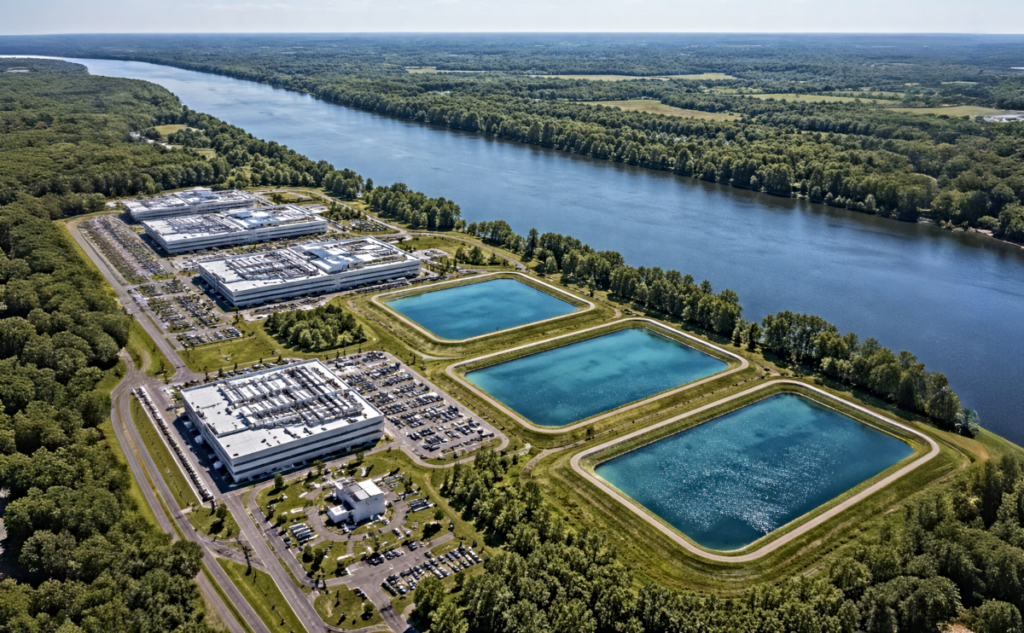
When people hear the words “data center,” the mental picture is usually bleak: a giant concrete box, noisy equipment, few jobs, and a company that disappears once construction wraps up.
That picture doesn’t match how Google operates its data center campuses — and that difference is why county commissioners say who the company is matters just as much as what is being built.
Not Just One Building — A Campus
Google doesn’t build one-off facilities. Its data centers are designed as multi-phase campuses that grow, adapt, and get rebuilt over time.
That means:
- Multiple buildings added over years
- Ongoing upgrades as technology changes
- Continuous construction instead of a single boom-and-bust cycle
In places like central Ohio, Google sites have been under near-constant construction for a decade or more, keeping skilled trades working locally rather than commuting hours away.
Union representatives told commissioners this week that Google campuses are routinely refreshed, expanded, and modernized — sometimes every few years — because the technology inside changes faster than almost any other industry.
What the Campuses Are Like Day to Day
Despite their size, Google campuses are typically:
- Quiet — designed with sound buffering and equipment housed indoors
- Low-traffic once operational — construction traffic fades, daily operations don’t generate congestion
- Visually screened — landscaping, setbacks, and buffers are standard
- Heavily regulated — water use, discharge, and power systems operate under state and federal oversight
Commissioners pointed residents to Google’s Ohio facilities located near schools and residential neighborhoods, noting that they coexist with surrounding communities without the noise or disruption many people fear.
Water, Energy, and Environmental Practices
Google is widely regarded as one of the more aggressive large companies when it comes to environmental planning — partly because data centers consume massive energy and water, and partly because scrutiny follows them everywhere they build.
Google data centers typically:
- Use closed-loop cooling systems to reduce water waste
- Rely on recycled or non-potable water sources when available
- Operate under EPA discharge permits similar to water treatment facilities
- Invest heavily in energy efficiency and grid reliability
In Ohio, Google has also partnered with utilities and energy providers to improve grid infrastructure — something commissioners said factored into their comfort level with the project.
Google’s Reputation as an Employer
For permanent employees, Google is consistently ranked among:
- The most competitive-paying tech employers
- Companies with strong benefits and job stability
- Employers with long-term retention, especially in technical and facilities roles
But the bigger impact in places like Scioto County may come from the construction side.
Union trades repeatedly describe Google as:
- A “clean site” that follows safety rules
- A company that honors labor agreements
- One that pays prevailing wages and benefits
- An operator that doesn’t cut corners to save money
That’s why trade unions often show up in support of Google projects — even when public sentiment is divided.
As one labor leader told commissioners:
“We know who the good operators are. Google is one of them.”
Community Investment and Charitable Work
Beyond construction and operations, Google campuses are often paired with local community investment, including:
- Grants to schools and workforce programs
- Support for STEM education and technology training
- Infrastructure improvements tied to site development
- Partnerships with local governments and nonprofits
Commissioners said Google’s willingness to engage directly with local officials — including site tours and in-person meetings — helped distinguish the company from developers who simply request tax breaks and disappear.
Why Commissioners Keep Saying “The Who Matters”
Throughout the debate, commissioners repeatedly returned to one point:
Scioto County doesn’t get to decide if development comes — but it does get to decide who it works with.
Google’s track record in Ohio gave commissioners something concrete to point to:
- Existing sites people can visit
- Workers who’ve already built them
- Communities that live next to them
“This isn’t speculation,” Commissioner Scottie Powell said. “You can go see it.”
The Bottom Line
Google campuses aren’t perfect — no mega-project is — but they are predictable, regulated, and well-documented.
For a county that hasn’t seen a major new development in more than two decades, commissioners say predictability matters.
Whether residents ultimately agree or disagree with the vote, one thing is now clear:
This isn’t an unknown company experimenting in Appalachia.
It’s a global operator with a long paper trail — and the commissioners say they’re prepared to hold accountable.