
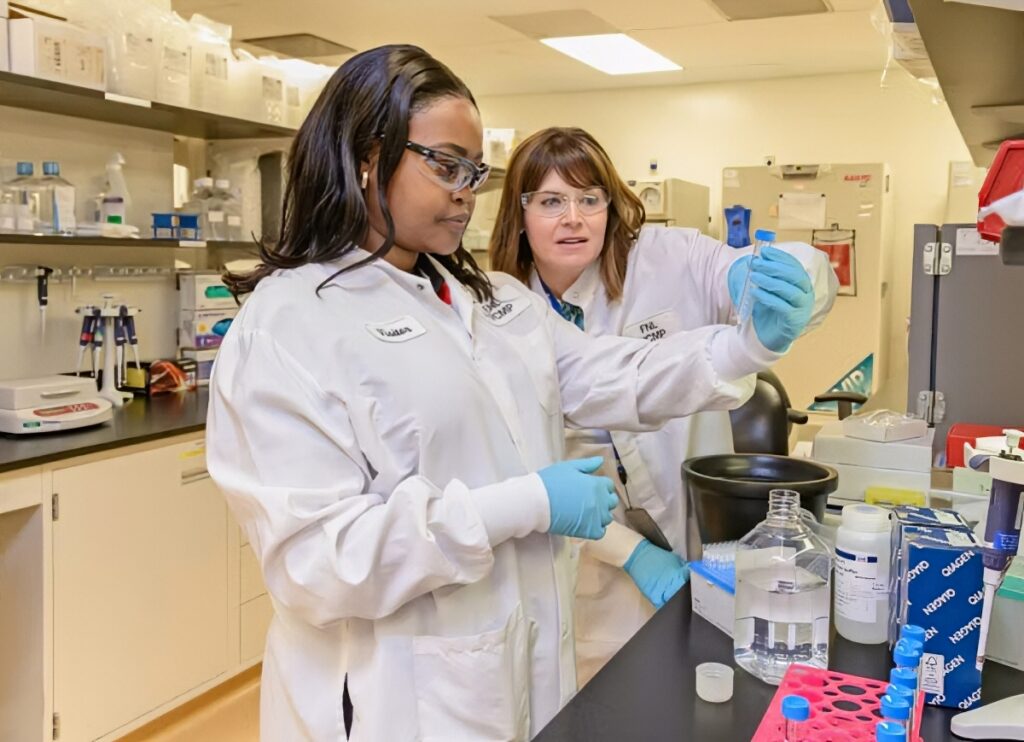
Enjoy problem-solving, but you want it to lead to something?
Biochemistry could be a great field for you. It combines chemistry and biology to help explain what is going on within organisms. These problems range from how cells obtain energy to how proteins interact.
However, if you enjoy difficult questions, it does not always translate to liking science. In biochemistry, you can spend hours or even days searching for your answer.
It all comes down to whether you think that would be fun or annoying.
Contents:
- Will You Be Solving Problems?
- How Does Chemistry Play a Role in Science?
- Do You Enjoy Working to Get Your Answer?
- Career Opportunities With a Biochemistry Degree
- Here Are 4 Things to Try if You Think You Would Enjoy Biochemistry
- What If You Don’t Think You’d Enjoy Biochemistry?
- Conclusion
Will You Be Solving Problems?
You will still have to know molecule names and shapes. But the problems become more about understanding how those molecules interact with each other.
Why might an enzyme work faster in one setting than another? Why would a mutation cause a cell to malfunction? What are the effects if you disrupt a normal pathway?
You know what information is already available; hypothesize and then find data that can disprove your theory.
Maybe the reaction occurred quicker due to a higher temperature, impurity in the reaction, or the equipment is inaccurate. You can then figure out why each option would cause these results and perform additional tests.
You may have found an interesting result; maybe your graph had 2 humps instead of 1. Is this true data, or were your samples cross-contaminated?
Having a result that makes sense isn’t enough; you have to know why it is happening. Which can be very rewarding if you enjoy problem solving.
How Does Chemistry Play a Role in Science?
Most problems will consist of a couple of fields working together. Chemistry allows you to understand the structure of the molecules and how they interact with one another. While biology will allow you to see what these molecules are doing in a body or organism.
Students can look into SERM research and what these compounds are used for. They can see why Enclomiphene is classified as a selective estrogen receptor modulator. Students can examine published studies to explore how molecular structure relates to receptor binding, what researchers measured, and what their results cannot establish about effects in people.
Of course, the goal isn’t for students to take SERM compounds, but for them to learn from these studies and apply that knowledge to everyday life. Whether you are looking at how an organism uses a pathway or why a protein denatures. Or how you can find trace amounts of something in a sample using certain techniques.
These are all problems that you can start digging into if you choose to major in biochemistry.
Do You Enjoy Working to Get Your Answer?
This part of the degree can help students decide whether biochemistry is a good fit.
Depending on your program, you may take organic chemistry, biology, genetics, biochemistry, math, and statistics. This can all depend on what program you choose to enroll in. Some may require you to complete more lab work than others and leave room for research or extra classes.
Knowing this material can be hard, but learning how it all connects can be even more challenging.
If you are working on a lab project, you may get a bad result. After checking your calculations, repeating the measurement, and inspecting the equipment, what would you try next?
If you enjoy figuring out what went wrong, you may like this type of career. If you just want to know the right answer, you may not enjoy working in science. Both are fine; it’s just what kind of career you may want to pursue.
Career Opportunities With a Biochemistry Degree
Biochemistry graduates may find roles in biotechnology, pharmaceuticals, food science, environmental testing, and laboratories. Some jobs will require you to work with samples, improve current technology, or conduct research.
The U.S. Bureau of Labor Statistics projects 12% employment growth for biochemists and biophysicists from 2025 to 2035. This is a forecast for one U.S. occupation, not for every graduate.
Just keep in mind this is for one occupation and only in the US. Not everyone will be working in these occupations after graduating with a degree in biochemistry.
Also, some entry-level positions will accept those with a bachelor’s in Biochemistry/Biophysics. Independent research and development generally requires a Ph.D. A biochemistry degree can also support applications to medical school and other programs, provided you meet their admission requirements.
It is always a good idea to gain experience while you are in school. Whether it be a summer research position, internship, or lab assistant job. It will show potential employers what you know and allow you to see if you enjoy working with that type of data.
Make sure you research what you want to do before picking out a program. What jobs do graduates from that program land? Will you be able to do research? And what kinds of jobs can you apply to after you graduate?
Here Are 4 Things to Try if You Think You Would Enjoy Biochemistry
Here are a few things you can do to help determine if you think you would enjoy this type of work.
- Read an abstract and look at the data from a research paper. Find a subject that you know about somewhat. Can you describe what question was asked, the data that was found, and one thing you learned? If yes, you may enjoy working in a lab setting.
- Complete a difficult problem in chemistry. Maybe one that you had to complete many steps to solve; did you enjoy working to find the answer?
- Speak with someone who is working in that field. Ask them what they do day to day. Are you interested in doing those tasks?
- Research classes that you will take; make sure there are chemistry, biology, math, computers, and research involved.
Another tip: find ways to incorporate working with data into your life. If you can understand graphs, know some statistics, or learn how to code. You will be able to use that in many labs and outside of the lab as well.
What If You Don’t Think You’d Enjoy Biochemistry?
As mentioned above, there are many majors that can satisfy your love of problem solving.
If you enjoy chemistry, you may want to pursue that as your major. If you are more interested in organisms, genetics, etc. Try looking into Biology, Molecular Biology, or Microbiology.
If you want to create things, try looking into Biomedical Engineering or Chemical Engineering. You may also enjoy Computer Science, Bioinformatics, etc.
There are many jobs that can use your skill set; just research what type of career you want to pursue and see what classes they may have in common.
Conclusion
Biochemistry can be a great major for someone who enjoys solving problems. Just remember, there are many things to consider before making your decision. Make sure you know what you are getting yourself into and enjoy the journey to find your answers!