
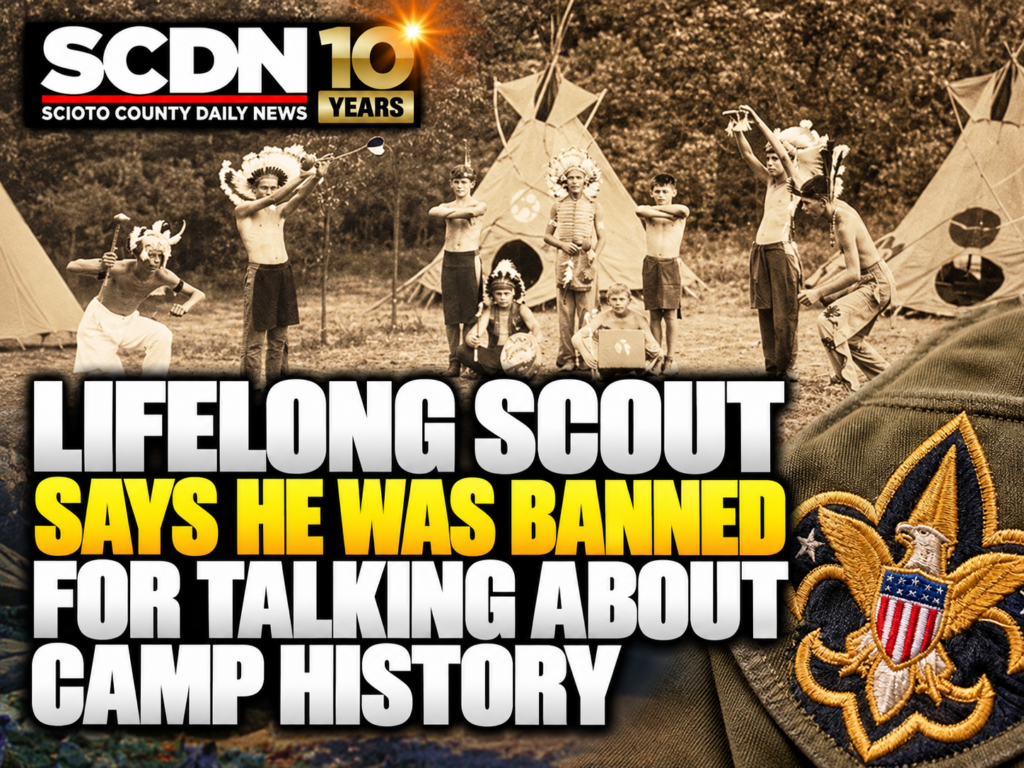
After more than 50 years in Scouting, a longtime volunteer says he has been kicked out for discussing a piece of history the organization would rather he leave alone.
Steve Hartlage, an Eagle Scout and chairman of Camp Oyo’s recent 100th anniversary celebration, says his membership was revoked after he mentioned a former Scout honor society called the Order of the White Swastika in a Facebook history post.
He says he was explaining the past, not endorsing the symbol.
An October 20 email from Simon Kenton Council Safety Director Jeff Vandeborne confirms that Hartlage was notified of his membership revocation. It tells him he can no longer attend Scouting meetings or activities, enter Scouting America property, wear the uniform, or represent himself as a registered member.
But the email does not explain the specific conduct behind that decision.
Scioto County Daily News contacted council officials with questions about the posts, the applicable policies, and the reasons for removing Hartlage. The council had not responded by publication.
A history project becomes a membership dispute
Hartlage says he created a Facebook group a little over a year ago to promote Camp Oyo’s centennial celebration. He used it to share photographs and stories about the camp and Scouting in the Portsmouth area.
Among those stories was the history of the organization he calls the Mystic Order of the White Swastika.
Hartlage says an initial post included old photographs of Scouts wearing its emblem and explained that the organization was abandoned in 1937 because of the rise of the Nazis.
According to Hartlage, council CEO Travis Gulling called and asked him to remove the post because Gulling and others considered it offensive.
Hartlage says he complied, then posted a revised version showing a historical requirements document instead of the photographs. He says Gulling asked him to remove that version, too, and he again complied.
“I stressed to him that it was not offensive as I was just reporting what had happened,” Hartlage told SCDN.
The dispute resurfaced after an October 7 post about what Hartlage believed could be an early Shawnee Lodge 109 Order of the Arrow ceremonial team at Camp Oyo.
His caption described a photograph marked “1939–40” and a notation indicating that a swastika above a tepee doorway had been painted over. It also mentioned the former honor society and the establishment of Shawnee Lodge in 1938.
Hartlage says that mention led to his suspension.
He says he spoke with Gulling on October 13 and asked what he had done wrong. According to Hartlage, Gulling told him he had violated the seventh point of the Scout Law, “obedient,” by disregarding an instruction not to mention the word again.
The council has not responded to SCDN’s request to confirm or dispute that account, including whether its earlier removal requests explicitly prohibited future discussion of the organization.
The history exists beyond his Facebook page
The former organization’s connection to Camp Oyo is documented on Tecumseh Lodge’s history website.
Its account says Shawnee Lodge 109 formed in 1938, with its first induction held that July at Camp Oyo. It also says many of the lodge’s initial members had previously been inducted into the Order of the White Swastika at Camp Oyo or Camp Lazarus.
The website identifies itself as a Tecumseh Lodge history project and carries a copyright notice naming Tecumseh Lodge, Simon Kenton Council, and the Boy Scouts of America.
That account supports the existence of the historical organization and its connection to local Scouting. It does not independently establish Hartlage’s stated 1937 abandonment date or identify the people in his photograph.
SCDN asked the council how it distinguishes the history published on that website from Hartlage’s post. It had not answered by publication.
An ancient symbol with a terrible modern association
The word “swastika” understandably brings Nazi Germany, antisemitism, and the Holocaust to mind. But the Nazis did not invent the symbol, and its appearance in an old photograph does not, by itself, establish a Nazi connection.
According to the United States Holocaust Memorial Museum, the symbol was used across different cultures for thousands of years before the Nazis adopted it. It represented good fortune or well-being and remains sacred in Hinduism, Buddhism, and Jainism.
The Nazi Party adopted the swastika in 1920 and turned it into an emblem of racist ideology and terror. It remains a powerful hate symbol when used by Nazi and white supremacist movements today.
That history makes context essential when examining older uses. Hartlage’s stated purpose was to explain an earlier camp organization and why its emblem disappeared.
His October caption discussed a symbol that had been painted over, rather than calling for its return.
From suspension to revocation
The council’s October 13 suspension letter referred broadly to allegations of “Membership Infractions.”
It prohibited Hartlage from participating in Scouting while officials gathered more information. The letter expressly said the suspension should not be taken as a finding that the allegations were accurate.
It also cited concern for Scout safety without identifying a specific safety allegation. SCDN asked whether that wording was standard language or referred to a particular concern in Hartlage’s case. The council had not answered.
Hartlage says Vandeborne interviewed him and told him to expect a decision by October 16. He says that date passed without an answer.
On October 20, Vandeborne emailed him following a telephone conversation to confirm the revocation and said a certified letter would follow.
Hartlage describes the action as a permanent ban. The email supplied to SCDN does not explain whether an appeal or reinstatement is available.
Decades of service, unanswered questions
Hartlage says his Scouting service includes work as a Cubmaster, Scoutmaster, district chairman, professional district executive, and camp director. He identifies himself as a Vigil Honor member and recipient of the Silver Beaver award.
Most recently, he helped organize the Camp Oyo centennial celebration, which he says drew more than 600 people.
He also described an earlier disagreement with council leadership over admission charges and funding for the anniversary dinner. He believes that dispute damaged his relationship with Gulling. SCDN has not established that it played any role in the membership decision.
For now, the documents confirm that Hartlage’s membership was revoked. His account identifies the history posts and an alleged instruction against mentioning the former organization as the reason.
The council has not publicly explained its decision to SCDN.
“I WILL NOT let history of any kind be put into the ‘Memory Hole,’” Hartlage wrote in his public account of the dispute.