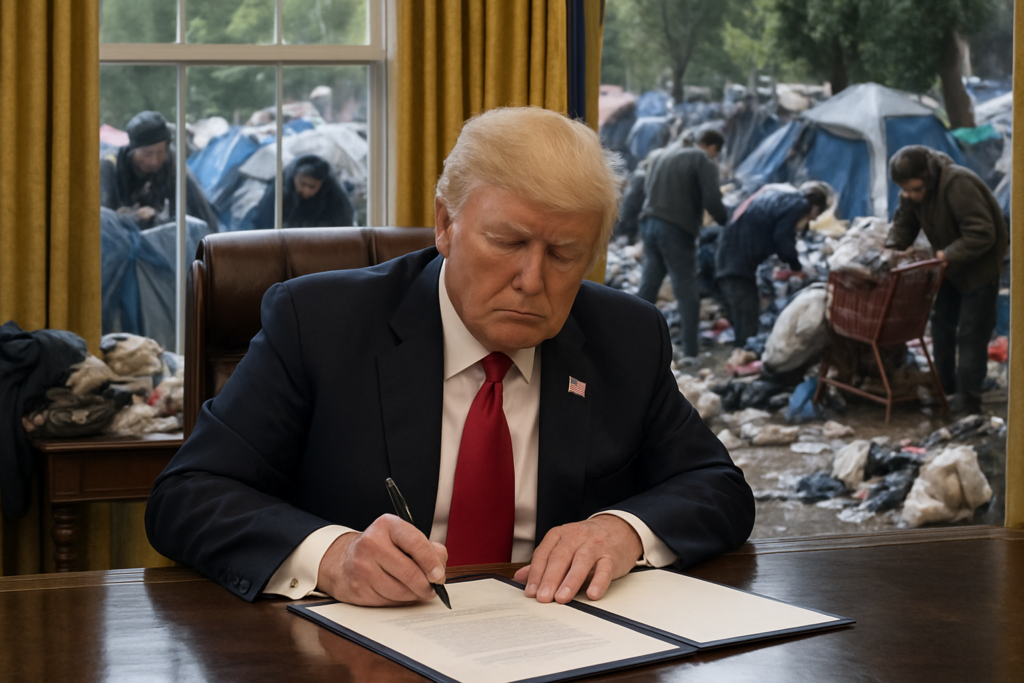
New Federal Homelessness Order Calls for Tougher Measures, But Will It Help Cities Like Portsmouth? 

A sweeping new executive order from the White House promises to overhaul how the federal government addresses homelessness—focusing less on short-term aid and more on public safety, civil commitment, and stricter rules for local programs. But as cities like Portsmouth, Ohio, struggle daily with visible, growing homelessness, some residents are asking: Will anything really change? 

🔁 A New Approach: Treatment Over Tolerance 

The order takes aim at what it calls “failed programs” and “harm reduction” efforts, blaming them for enabling street-level drug use, worsening mental illness, and making public spaces unsafe. It pushes for: 

The idea, according to the order, is that simply housing individuals without requiring treatment has failed—and it’s time to bring back “institutional settings” for those who cannot care for themselves. 

🧠 The Mental Health Crisis Takes Center Stage 

One of the most controversial parts of the order is its call for expanding civil commitment—essentially involuntarily placing people with mental illness or substance use disorder into treatment centers. The federal government says this is necessary because far too many people living on the street are dangerously unwell. 

The order also opens the door for federal funding to be used to remove homeless encampments where public safety is considered at risk, and to build more forensic mental health beds so those arrested don’t get turned loose due to lack of space. 

🚫 What It Doesn’t Do 

What the order doesn’t provide is new funding for long-term housing, new shelter space, or non-law enforcement outreach. It also doesn’t mandate action from states or cities—only that those who comply with the federal framework may receive priority access to grants. 

And while the order mentions transitional services and outpatient support, it does not specify how those services will be staffed or funded, especially in rural or underserved communities like Scioto County.  

💬 What Does This Mean for Portsmouth? 

In Portsmouth, the homeless crisis is not just a political talking point—it’s a daily reality. With nine known large homeless camps and a growing population of mentally ill individuals arrested and released over and over again, the city’s streets have become what some are calling an “open-air asylum without walls.” 

Earlier this year, city officials floated the idea of forming a Homeless Task Force—a collaborative approach that would bring together city leaders, nonprofits, and law enforcement. But since the announcement, no public action has been taken, and the crisis only seems to be deepening. Residents see the same people cycling through jail, emergency rooms, and business doorways. Police are left with few tools—and even fewer long-term options. 

🤷‍♀️ Will Portsmouth Qualify for Help? 

It’s unclear whether Portsmouth, which currently has limited resources for mental health treatment and shelter space, will qualify for the grant preferences tied to the new executive order. The city would need to show aggressive enforcement of camping bans, public drug use, and squatting, while also demonstrating efforts to provide institutional care. 

But critics warn that without new local funding, inpatient treatment beds, or shelter capacity, Portsmouth may be left stuck in the same place—except now with even tighter rules and less flexibility.  

📉 One More Policy, Still No Beds 

The executive order lays out a bold—and in some cases, controversial—vision for addressing homelessness. But it places the burden of action largely on local governments, many of which are already overwhelmed. 

In Portsmouth, that means the daily arrests, 911 calls, and revolving door of untreated mental illness may continue unless and until real, coordinated investment in housing and treatment arrives. 

As one frustrated resident put it after seeing the same woman arrested twice in one day: “This isn’t just a crisis—it’s a system failure.” 

🔍 What’s Really in the Executive Order? 

A Closer Look at the Federal Push to Rein in Street Homelessness 

The executive order outlines a new federal framework for tackling homelessness—shifting away from “housing first” approaches and toward mandatory treatment, stricter law enforcement, and institutional care. Here’s a deeper dive into several of the most impactful provisions:  

🧠 1. Expanded Civil Commitment & Step-Down Treatment Support 

The order directs the federal government to help states and cities implement more flexible civil commitment laws that allow mentally ill individuals to be institutionalized for care—even if they’re not actively violent but simply unable to care for themselves. 

What that means: 

For Portsmouth: 

This could open a path for Scioto County and city officials to access support for building or partnering with inpatient psychiatric facilities—something currently lacking in the region. The challenge? Ohio’s civil commitment laws already require significant legal thresholds for involuntary treatment, and few facilities are equipped to handle long-term psychiatric care.  

🚔 2. Emergency Federal Law Enforcement Assistance for Encampment Removal 

Another major directive: the U.S. Department of Justice will unlock emergency law enforcement funding to support encampment removals in areas where public safety is threatened and local governments lack the manpower or resources. 

What that means: 

For Portsmouth: 

With at least nine large homeless camps and frequent reports of violence, drug use, and unsafe living conditions, the city could potentially apply for this funding—but it must show it lacks the local resources to act alone. This could also come with federal scrutiny over how those displaced are treated, especially if adequate shelter or treatment isn’t available.  

🏥 3. Stop-Gap for Mentally Ill Detainees Without Forensic Beds 

The executive order also addresses a critical bottleneck in the criminal justice system: jails releasing mentally ill detainees not because they’re safe, but because there’s nowhere to put them. 

What that means: 

For Portsmouth: 

Police frequently encounter mentally ill individuals cycling through the Scioto County Jail multiple times a week. But with no local psychiatric hospital, and with state forensic beds hours away, many are simply released after arrest. This federal evaluation could result in funding or facility expansions—but only if local governments push for it.  

🏚️ 4. In-Custody Release Planning for Offenders with Mental Health Needs 

Finally, the order demands tougher rules for release planning at prisons and residential reentry centers—ensuring that inmates, particularly those with mental illness, don’t get released into homelessness without a plan. 

Please Support This Local Business

What that means: 

For Portsmouth: 

This provision could help slow the revolving door of jail-to-street-to-jail for some of the city’s most chronically homeless residents. But again, it depends on capacity. Without local rehab or psychiatric facilities to send them to, these plans may be unenforceable.  

⚖️ Bottom Line: A Stick Without a Safety Net? 

The executive order clearly represents a major philosophical shift: away from passive tolerance of street homelessness and toward mandatory treatment and stricter enforcement. But for places like Portsmouth, the key question is: 

Will the resources to build treatment beds, shelter space, and long-term care actually follow? 

If not, cities may find themselves pressed to enforce new rules without any realistic options for where to send the people they remove from streets and parks. 

And in Portsmouth, where one troubled woman has been arrested six times in a single week, and businesses file daily complaints about panhandling and erratic behavior, a real solution is long overdue. 

Until federal dollars and local leadership align, it may just be another directive from Washington… and another night in a tent for someone in Tracy Park. 

Exit mobile version