

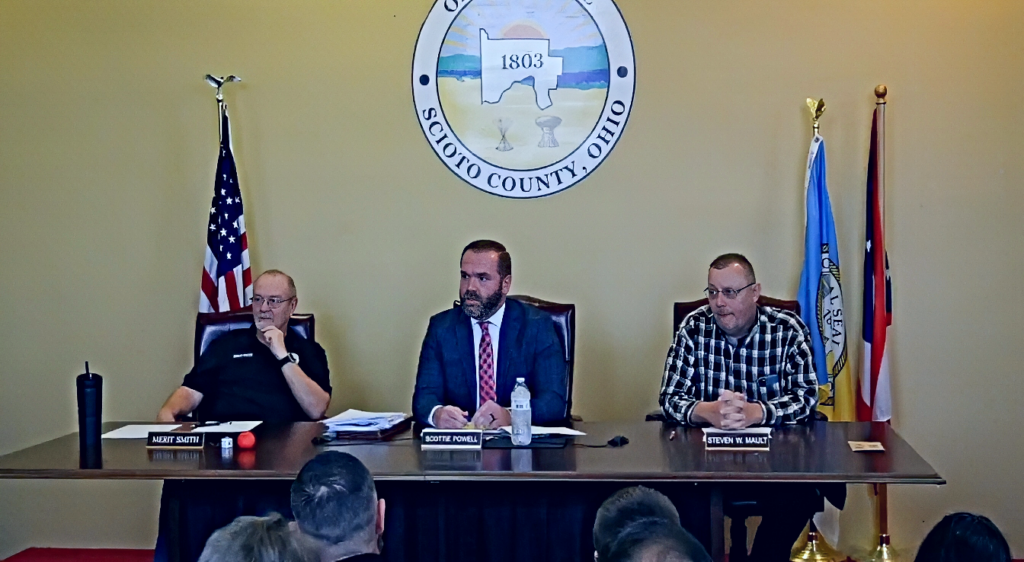
A standing-room-only crowd packed Thursday’s Scioto County Commissioners meeting following last week’s announcement that the county is considering tax incentives tied to a proposed $1 billion data center project in northern Scioto County.
The crowd was so large—and emotions so high—that Scottie Powell moved discussion of the data center to the very start of the meeting to allow residents to ask questions and voice concerns before the rest of the agenda continued.
At the heart of the discussion was a point commissioners repeatedly emphasized: they are not voting on whether a data center comes to Scioto County. The vote scheduled for January 22 is solely about whether the county will grant a tax abatement—and under what terms.
“It’s Not If — It’s Which Company”
Commissioners explained that the project is still under a non-disclosure agreement (NDA), preventing them from naming the company involved. However, Powell said a Fortune 100 technology company approached the county last year about locating a data center on private property in Haverhill.
“The county does not control the land, and we do not control permitting,” Powell said. “That’s not what we are deciding.”
He added that the site has already attracted interest from multiple developers.
“In my estimation, it’s not if it’s a data center—it’s which company,” Powell said.
The property lies within an established industrial corridor and was previously designated as part of a Community Reinvestment Area (CRA), which allows companies to request tax abatements for qualifying projects.

What’s Being Proposed
Under the current proposal, the project would involve:
- A $1 billion investment
- Roughly 500,000 square feet of building space
- Approximately $500 million in machinery and equipment
- Around 50 full-time permanent jobs
- Up to 1,300 construction jobs at peak buildout
The tax abatement would apply only to new improvements, not the land itself. Commissioners outlined the key financial terms:
- 75% abatement on improvements for 15 years
- Land remains fully taxed
- Payment in Lieu of Taxes (PILOT) starting at $500,000 annually
- Additional PILOT payments tied to square footage
- If the site expands to 1.5 million square feet, the PILOT could exceed $1.1 million annually, in addition to base property taxes
Powell noted that schools would continue to receive the same tax revenue from the land, plus revenue from the remaining 25% of the taxable improvements.
Local Labor a Key Condition
Both Powell and Merit Smith stressed that the county insisted on firm language requiring the developer to work with local labor and local trade unions.
“We went back and forth on that,” Powell said. “We felt it was critical.”
As part of the agreement, the company would be required to submit annual reports detailing its outreach and use of local labor.
Smith echoed that position.
“We could have walked away from this project if they weren’t willing to do that,” he said.
Emotional Public Concerns Raised
One woman, visibly emotional, spoke on behalf of many residents who oppose data centers nationwide, raising concerns about environmental and health impacts.
She cited studies and reporting that claim data centers:
- Produce continuous noise and light pollution
- Consume 1 to 5 million gallons of water per day
- Discharge treated wastewater into local waterways
- Increase electricity demand and potentially raise rates
- Create relatively few permanent local jobs
She urged commissioners to slow the process and hold additional public hearings, warning that the county “cannot risk even the hint of a lack of transparency.”
Labor Leaders Speak in Support
Labor representatives offered a sharply different perspective.
Bobby Cole, business manager for local pipefitters, said many area tradespeople have been forced to travel for work for years.
“Since 2009, we haven’t had a lot of projects here,” Cole said. “We currently have 65 members traveling to Columbus—95% of them working on data centers.”
He said that in 2024, those workers averaged more than $204,000 in wages and $100,000 in pension contributions.
“I fully support this data center,” Cole said.
A representative from the Tri-State Building and Trades Council added that the economic impact would extend far beyond the initial 50 permanent jobs.
“This is phase one,” he said. “This could be 10 to 15 years of opportunity for local people.”
Addressing Water, Noise, and Oversight
Powell said he personally toured a data center facility and found the noise level lower than that of a nearby highway.
On water usage, he said the company plans a dual-source strategy:
- Cooling water would not impact Portsmouth’s water supply
- Water would be drawn from the Ohio River, treated, and discharged under EPA oversight, similar to other water treatment facilities
Powell said the company shared sustainability plans, but details remain restricted under the NDA.
“I can’t say there’s a concern you raised that I haven’t had myself,” he told residents.
Schools Ask About Revenue Impact
Jodi Armstrong, Green Schools Superintendent, asked how the project would affect school funding, noting the land is currently taxed as agricultural property.
Commissioners said estimates provided by the company show significantly higher revenue than what the farmland currently generates—even with the abatement.
“You will never get any less,” Smith said.
What Comes Next
Commissioners reiterated that the only vote before them is on the tax abatement agreement, not zoning or site approval, which occur at the township level.
Powell said the county hired a law firm experienced in negotiating data center agreements and researched how the company has operated in other communities.
Once the discussion concluded and the formal meeting resumed, most of the crowd exited the room.
“Anybody want to stay?” Powell joked. “We’re still having a meeting.”
Commissioners said they are considering evening meetings to allow more residents to participate before the January 22 vote.
“This is important,” Smith said. “And we appreciate everyone who came out to be part of the conversation.”