
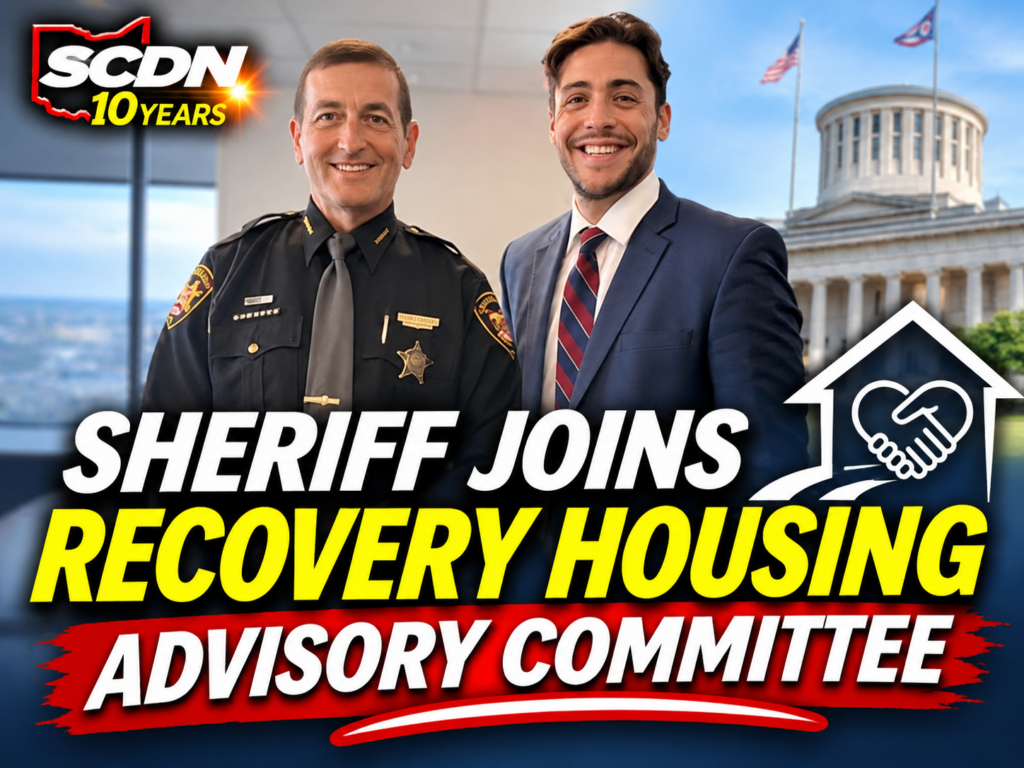
Scioto County Sheriff David Thoroughman is taking on a new statewide role as Ohio works to tighten oversight of an industry that has become a major issue in Southern Ohio.
Thoroughman announced that he has been selected to serve on the Recovery Housing Residence Advisory Committee at the Ohio Department of Behavioral Health.
He said State Representative Justin Pizzulli invited him to join the committee, where Thoroughman will represent both law enforcement and Scioto County.
For a county that has spent years sounding the alarm over the rapid growth of recovery housing, the appointment gives local law enforcement a direct voice in the state-level discussions about how those homes should operate and be monitored.
“Recovery housing plays an important role in helping people rebuild their lives, and it affects the safety and well-being of our whole community,” Thoroughman said in a social media post announcing the appointment.
“Our county has seen the impact of addiction firsthand. It’s important that law enforcement has a seat at the table when decisions are made about how recovery residences operate and are overseen.”
From Testifying to Helping Shape Policy
This is not Thoroughman’s first trip to Columbus over the issue.
Earlier this year, he joined Scioto County Commissioner Scottie Powell in testifying before an Ohio Senate committee in support of House Bill 58, legislation aimed at strengthening oversight of recovery housing. State records confirm both men testified as proponents of the bill.
That legislation was sponsored by Pizzulli and State Representative Dontavius Jarrells and passed the Ohio House with provisions aimed at statewide standards, tougher enforcement and increased accountability for recovery housing operators.
Now Thoroughman will have an ongoing advisory role as Ohio continues reworking the system.
“I’ll be bringing the perspective of Scioto County and the Sheriff’s Office to these discussions,” he said. “I’ll keep working with state and local partners on solutions that support those in recovery while keeping our neighborhoods safe.”
Scioto County Has Been Ground Zero
The appointment comes just months after Governor Mike DeWine signed an executive order giving the Ohio Department of Behavioral Health authority to create a centralized statewide certification system for recovery housing.
State officials said the number of recovery houses in Ohio exploded from 356 in 2022 to more than 1,700 by 2026. The state specifically pointed to uncertified homes and unsafe or poor living conditions in Southern Ohio as reasons stronger oversight was needed.
That statewide growth has been especially noticeable in Scioto County.
Local officials previously said the county had more than 110 recovery houses, roughly the same number as Franklin County despite the enormous difference in population.
Commissioners, law enforcement and residents have repeatedly argued that Scioto County has absorbed a disproportionate share of Ohio’s recovery housing system.
The concern has not generally been about recovery itself.
Instead, local officials have focused on bad operators, overcrowded homes, poor living conditions, insufficient oversight and the impact some facilities can have on neighborhoods, law enforcement, EMS, courts and other public services.
State Now Has More Power to Act
Under DeWine’s executive order, the Department of Behavioral Health gained authority to administer certification statewide, set consistent standards, receive complaints, investigate problems and enforce compliance.
The department can also refer suspected fraud, waste or abuse to the Ohio Attorney General’s Office.
The state has already taken action against operators in Portsmouth.
In late 2025, the Department of Behavioral Health sought an injunction against STEP Wellness over seven Portsmouth recovery residences that state officials said were operating without required accreditation. A Scioto County judge ordered those locations to stop operating.
Pizzulli has also pushed legislation aimed at closing loopholes, strengthening certification requirements and giving local officials more tools to deal with noncompliant operations.
Balancing Recovery and Neighborhood Safety
The challenge for the new committee will be finding that balance.
Recovery housing can provide a stable, drug- and alcohol-free place for people trying to rebuild their lives. Ohio describes those homes as places where residents can establish routines, receive peer support and continue their recovery.
But Scioto County leaders have repeatedly argued that responsible providers should not be lumped together with operators who ignore rules or exploit vulnerable people.
That is the perspective Thoroughman says he plans to bring to Columbus.
For years, Scioto County officials have asked who was watching the recovery houses.
Now the sheriff will be one of the people sitting at the table while Ohio works on the answer.