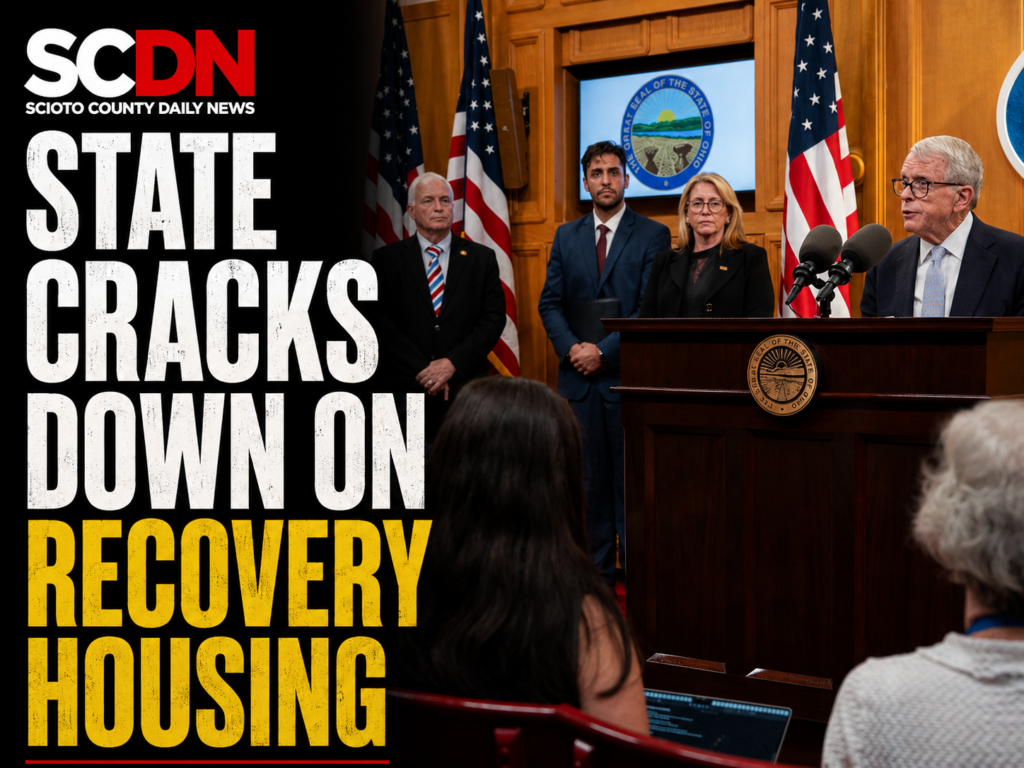
Ohio is moving to tighten oversight of recovery houses after explosive growth in the industry, with state officials specifically pointing to unsafe and uncertified homes in Southern Ohio.
Governor Mike DeWine signed an executive order giving the Ohio Department of Behavioral Health the authority to create a statewide certification program for recovery housing operators.
For Scioto County, the issue is not theoretical.
Local officials and residents have been warning for years that the county is carrying a heavy share of Ohio’s recovery housing burden, while bad operators, weak oversight, and poor living conditions have fueled public frustration.
State officials said the number of recovery houses in Ohio has jumped from 356 in 2022 to more than 1,700 today.
DeWine said recovery housing can provide hope and stability for people trying to rebuild their lives, but said the state has a responsibility to make sure the programs operate with accountability, transparency, and integrity.
“As Ohio continues to invest in behavioral health and recovery services, we have a responsibility to ensure these programs operate with the highest levels of accountability, transparency, and integrity,” DeWine said.
Under the emergency rules, the Ohio Department of Behavioral Health will run a centralized statewide certification program, set higher standards, receive complaints, investigate problems, and enforce compliance.
The department will also be able to refer suspected fraud, waste, and abuse to the Ohio Attorney General’s Office.
Attorney General Andy Wilson said his office is ready to assist state regulators and local prosecutors.
“We have zero tolerance for fraud,” Wilson said. “If bad actors try to exploit this program, we will deploy the full weight of our legal resources to hold them accountable and ensure compliance.”
Scioto County Has Been Sounding the Alarm
Scioto County officials have repeatedly raised concerns about the number of recovery houses operating locally.
Last year, Commissioner Scottie Powell said officials discovered Scioto County had more than 110 recovery houses — about the same number as Franklin County, even though Franklin County has around 1.2 million people compared to Scioto County’s roughly 72,000.
“This is completely out of balance,” Powell said at the time.
Powell, Scioto County Sheriff David Thoroughman, and Prosecutor Shane Tieman have all testified in Columbus in favor of stronger rules for the industry.
Local leaders have stressed that the issue is not recovery itself.
The concern is bad operators, overcrowding, unsafe housing, lack of accountability, and the strain placed on neighborhoods, law enforcement, EMS, courts, social services, and local residents.
That concern has only grown as citizens have reported more people sleeping outside, more calls involving treatment clients, and more frustration over the feeling that Scioto County has become a destination point for recovery housing without enough tools to regulate it.
Citizens Say the Burden Is Real
Residents have also raised questions about fairness and the long-term benefit to the community.
One citizen previously told SCDN the issue is not just the number of houses but the imbalance.
“Housing is paid for. Counseling is paid for. There are privileges they have that my friends can’t afford,” Brook said. “They get to hang out at the park playing basketball. Why aren’t they picking up trash? Where’s their skin in the game?”
He said if there is no lasting benefit to the community, it becomes a poor investment.
That frustration has helped fuel backlash in Scioto County, even among people who say they support recovery and want people to get well.
State Senator Terry Johnson, of McDermott, said Scioto County has been bearing much of the burden for the state.
“I have never met a single person who hasn’t wanted to see someone recover from drug addiction,” Johnson said. “Yet, Scioto County is bearing much of that burden for the state, and that is difficult for many in our community to reconcile, to the point there has even been a backlash against those trying to get well.”
Johnson said the order targets bad actors in recovery housing and said residents want a solution now.
State Representative Justin Pizzulli also praised the move.
“When someone reaches out their hand for help, we have a responsibility to make sure the hand reaching back isn’t there to exploit them,” Pizzulli said. “Today marks a new chapter for Southern Ohio.”
Recovery Housing Still Matters
State officials also emphasized that legitimate recovery housing plays an important role.
Recovery houses are meant to provide safe, substance-free places where people can rebuild routines, learn life skills, and get peer support while continuing recovery.
DBH Director Tia Marcel Moretti said most recovery housing providers are dedicated professionals trying to help Ohioans rebuild their lives.
“They deserve a fair, transparent, and consistent regulatory framework that recognizes quality, protects residents, and promotes public trust,” Moretti said.
That is an important point in Scioto County, where the public debate has often become heated.
Good recovery housing can help people stay sober, avoid homelessness, reconnect with family, and stay out of jail. But bad recovery housing can exploit vulnerable people, damage neighborhoods, and turn public support into anger.
The state’s new order is aimed at separating responsible providers from bad actors.
More Local Control Could Be Next
State Representative Brian Lorenz said Ohio also needs to look at zoning laws so communities have better tools to deal with where recovery housing is located and how it fits into neighborhoods.
Lorenz said he is working on legislation to modernize zoning laws, preserve local decision-making, and give communities more flexibility.
That could matter in places like Scioto County, where residents and officials have argued that recovery housing growth has far outpaced the county’s size and resources.
For now, the executive order gives the state new authority to certify, monitor, investigate, and enforce standards for recovery housing operators.
For Southern Ohio, it is a long-awaited step toward answering a question local residents have been asking for years:
Who is watching the recovery houses?
