
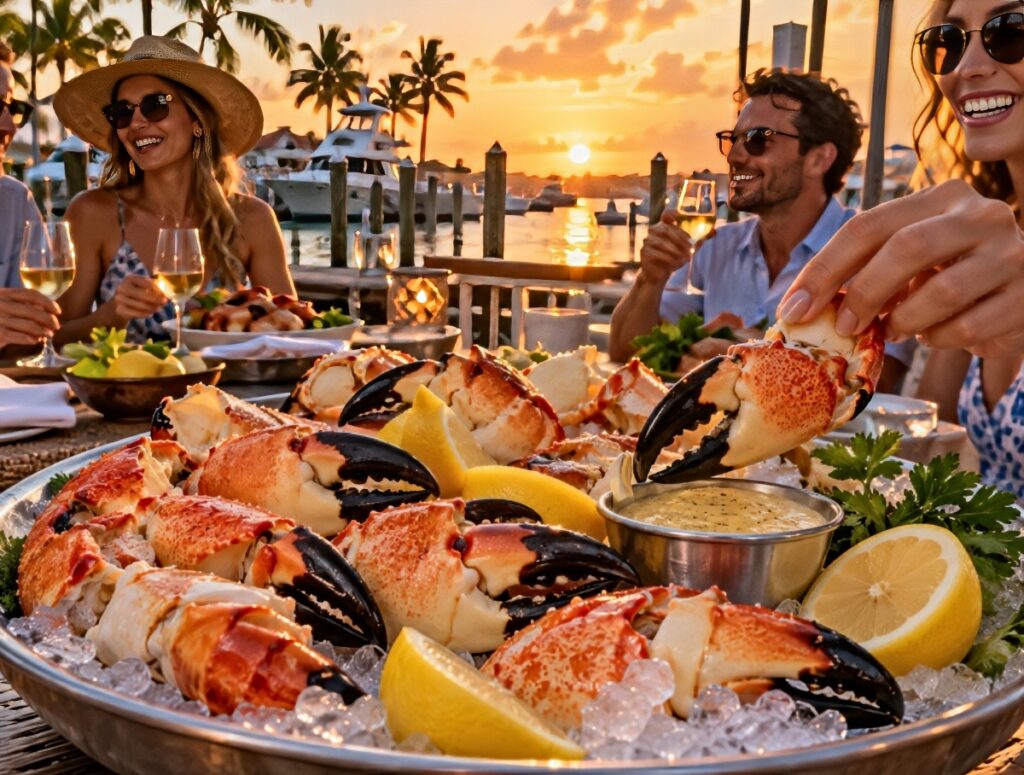
Ninety-seven percent of the stone crab claws eaten in the United States come from Florida. Not “mostly Florida.” Not “Florida and a little bit of Georgia.” Florida, almost exclusively. That single fact explains why the October opener of stone crab season turns South Florida coastal towns into something resembling a college football rivalry weekend, except the tailgate serves chilled claws with mustard sauce instead of hot dogs.
If you’ve never planned a trip around a seafood season before, stone crab is the one to start with. The combination of strict sustainability rules, a hard calendar window, and genuinely irreplaceable flavor makes this a seafood experience you can’t recreate at home on an average Tuesday. Here’s what drives the excitement, how the harvest actually works, and what to know before you book your table.
A Season Built Around One Rule That Changes Everything
The stone crab harvest is unlike any other commercial fishery in the country. Fishermen don’t keep the crab. They pull it from a baited trap, remove one claw, and drop it back into the water. According to the Florida Department of Agriculture and Consumer Services, Florida law forbids harvesting whole stone crabs entirely, and a claw removed properly regenerates in roughly 18 months. The fishery closes for five months each year to protect breeding cycles, which is why the season running from October 15 through May 1 is a non-negotiable hard stop.
That closing date is also why opening day carries so much energy. You genuinely cannot get a fresh-cooked Florida stone crab claw in June. The five-month closure is a feature, not a flaw. Scarcity, when it’s built on ecological logic rather than marketing, creates real anticipation. And the claws harvested in mid-October, right at the start of the season, tend to be among the meatiest of the year.
The minimum harvest size is 2 7/8 inches across the propodus (the larger section of the claw). Anything smaller goes back. Claws from egg-bearing females are off-limits entirely. These rules aren’t suggestions. The Florida Fish and Wildlife Conservation Commission enforces them actively, and the fishery is a direct product of that discipline.
The Claw-Size Decision Table: How to Order Like You Know What You’re Doing
Stone crab claws are sold in four size grades. Most first-timers default to “jumbo” without knowing what they’re actually getting, so here’s a practical breakdown before you sit down at the menu.
| Claw Grade | Approximate Weight Per Claw | Best For | Notes
|
|---|---|---|---|
| Medium | 3–5 oz | First-timers, smaller appetites | Often sweeter, more tender texture |
| Large | 5–7 oz | The everyday order for enthusiasts | Best price-to-meat ratio at most markets |
| Jumbo | 7–9 oz | Special occasion dining | Impressive presentation, slightly firmer meat |
| Colossal | 9+ oz | The splurge order | Rare at retail; priced accordingly |
Personally, large claws are where I’d put my money every time. The price jump to jumbo rarely matches the actual increase in eating enjoyment, and the meat in a large claw is usually more consistent. Save the colossal for a birthday dinner where someone else is picking up the check.
Why Florida Owns This Fishery Completely
Stone crabs exist from North Carolina down through Texas, but commercial harvesting at any meaningful scale happens almost entirely in Florida. The warm coastal waters of the Gulf of Mexico and the Atlantic side of the state create ideal habitat. The result is a fishery that generates real economic weight.
In 2024, Florida fishermen landed 96.5 million pounds of seafood worth $240.5 million in wholesale value, generating more than $365.2 million in total economic impact, according to the Florida Department of Agriculture and Consumer Services. Stone crab is one of the top ten species by volume in that harvest, which puts it in elite company alongside grouper, shrimp, and spiny lobster.
Zoom out further and the picture gets even bigger. In 2023, Florida’s ocean-related activity sustained approximately 909,000 jobs, generated $59 billion in labor income, and contributed $96 billion in Gross State Product, representing over 6% of the state’s total economic output, according to Florida Atlantic University. The seafood sector, including stone crab, is one of the pillars holding that number up.
And nationally? According to NOAA Fisheries’ 2023 Fisheries Economics of the United States report, commercial fishing and the seafood industry generated $173 billion in sales impacts across the country, with Florida ranking among the leading states. These aren’t abstract figures. They represent boats leaving the dock at 4 a.m., processors cracking claws before sunrise, and restaurants staying open late because the dinner rush doesn’t stop until 10 p.m.
The Clawsworth Ladder: A Framework for Deciding Where to Eat
Here’s a simple decision framework I call the Clawsworth Ladder. Use it to sort any stone crab dining option from “acceptable” to “the right call.”
- Does it have waterfront access? Stone crab tastes better with an Intracoastal view. This is not scientifically provable but it is empirically true.
- Does it source directly from Florida fishermen? “Fresh Florida stone crab” is not the same as “stone crab.” Ask the question. A good restaurant has a real answer.
- Is the mustard sauce house-made? The commercial stuff is fine. House-made is a signal that the kitchen cares about the whole plate.
- Can you also buy claws to take home? A restaurant with an attached market or shipping operation tends to move more product, which means fresher supply.
Restaurants that clear all four rungs are rare but they exist. Places like Billy’s Stone Crab in Hollywood, Florida, combine waterfront dining with a working seafood market and nationwide shipping, which means the supply chain is short and the claws are not sitting in a warehouse somewhere between you and the ocean.
“The claws harvested during this period are at their peak in flavor and texture, making them a sought-after delicacy.”
That’s the consensus among Florida seafood professionals, and it tracks with the biology. The claw meat is densest and sweetest in the weeks right after the season opens, before the crabs have had repeated encounters with traps.
Shipping Stone Crab: What the Off-Season Actually Looks Like
The season closes May 1, but stone crab doesn’t disappear from American tables. Claws harvested before closing day can still be shipped legally after that date, which is why overnight seafood delivery has become a meaningful part of the market. If you’re in a landlocked state, this is your realistic path to eating a Florida stone crab claw without booking a flight to Fort Lauderdale.
The key detail: cooked claws are typically sold already steamed, which means they’re served chilled, not reheated. Serving them cold with a sharp mustard dipping sauce is the standard Florida approach, and it’s a better eating experience than most people expect from mail-order seafood. The shell is dense enough to protect the meat during shipping, which is part of why stone crab travels better than most other shellfish.
If you do visit South Florida between October and May, plan the stone crab meal first and build the rest of the itinerary around it. The season is long enough that you won’t feel rushed, but short enough that skipping it feels like a genuine loss. The claw’s on the table for seven months. The excuse not to try it is harder to defend.