
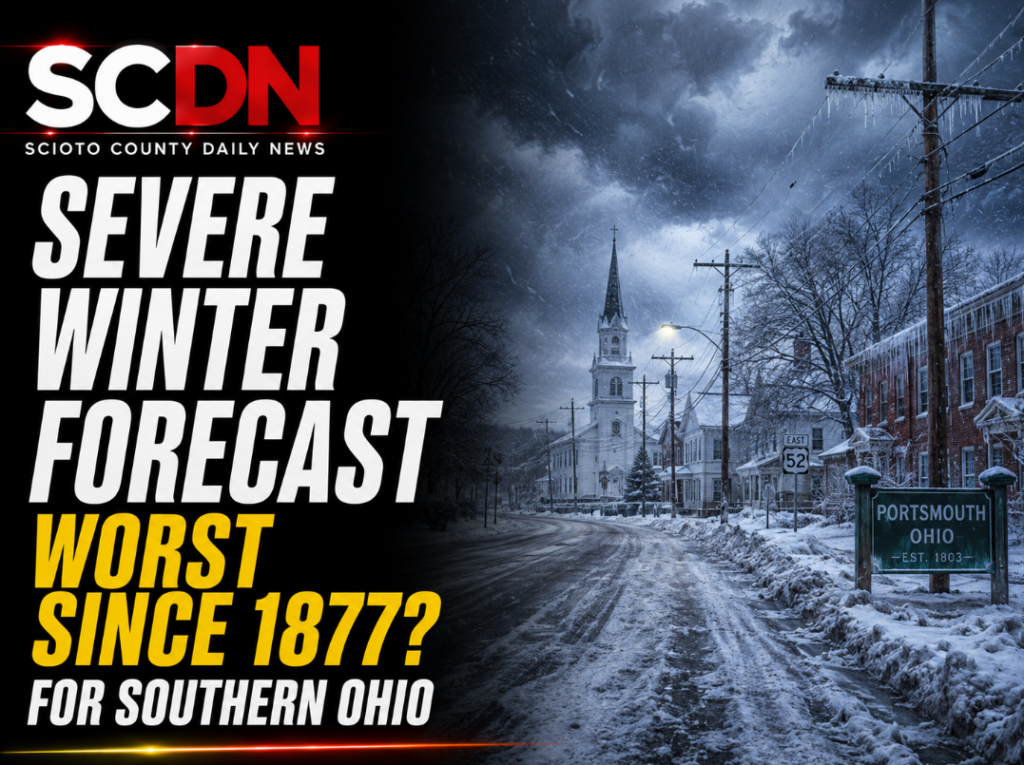
Winter 2026 Worst Since 1877 is the claim spreading across viral videos and social media, with some posts warning that the coming winter could be one of the most severe Americans have seen in nearly 150 years. SCDN did a thorough analysis on this claim, and here’s our report to you.
The short answer is simple:
There is no official NOAA or National Weather Service forecast saying Southern Ohio will experience its worst winter since 1877.
There is, however, a legitimate weather story behind the viral claim.
A powerful El Niño is developing in the Pacific Ocean, and the NOAA Climate Prediction Center says there is now a greater than 90% chance that it will become a very strong El Niño during the fall and winter of 2026-27. NOAA has also said there is a significant chance that the event could rank among the strongest in its modern record.
That is unusual.
It is worth watching.
But it does not mean Southern Ohio is facing a repeat of 1877.
Why Is 1877 Suddenly Being Mentioned?
The phrase Winter 2026 Worst Since 1877 appears to be connected less to Ohio winter history and more to comparisons between the developing El Niño and the extraordinary global climate event of 1876-78.
Research published by the American Meteorological Society found that 1877 was part of a devastating global drought period associated with a powerful El Niño and other ocean and atmospheric conditions.
That event contributed to catastrophic crop failures and famine in parts of Asia, Africa and South America.
But that does not mean Ohio suffered its coldest winter in 1877.
In fact, some historical weather accounts describe the winter of 1877-78 as unusually mild across portions of the eastern United States.
So when a viral video says the Winter 2026 Worst Since 1877 claim means Southern Ohio is headed for historically brutal cold and snow, the historical comparison itself becomes questionable.
The 1877 reference is primarily significant because of the global El Niño and drought disaster — not because Portsmouth experienced some legendary frozen winter.
What NOAA Is Actually Forecasting
The NOAA Climate Prediction Center says El Niño is strengthening rapidly.
El Niño matters because unusually warm Pacific Ocean water can shift atmospheric circulation and alter the jet stream.
That can change storm tracks, rainfall and temperature patterns thousands of miles away.
But El Niño does not create the same weather everywhere.
Ohio University climatologist Ryan Fogt has explained that El Niño can favor cooler conditions in the region, but that influence competes with the broader warming trend.
For Southeastern Ohio, the result could be a winter that finishes near normal overall.
That is a long way from predicting the worst winter in nearly 150 years.
Near Normal Does Not Mean Easy
This is where long-range forecasts are commonly misunderstood.
A winter that finishes near normal can still contain a dangerous week or two.
Southern Ohio could experience Arctic outbreaks, significant snowstorms, freezing rain, rapid temperature swings or heavy rain followed by flash freezing.
Seasonal forecasts deal with averages over months.
They cannot tell us in August whether Portsmouth will receive a major snowstorm on a particular January weekend.
A winter could have several days of extreme cold followed by weeks of mild weather and still finish statistically close to normal.
That is why Winter 2026 Worst Since 1877 cannot be verified simply because a strong El Niño is developing.
How Many Freezing Days Are Normal in Portsmouth?
For Southern Ohio residents, this may be a more useful number than a viral comparison with 1877.
Climate data for the Portsmouth-Sciotoville area show that freezing temperatures are a normal part of winter, with the typical cold season stretching from late November into March.
Recent local records available through Extreme Weather Watch show substantial year-to-year variation rather than a consistent pattern of increasingly severe winters.
A review of the most recent decade suggests Portsmouth typically sees roughly 90 to 100 nights per year at or below freezing, although colder winters can exceed that range and milder winters can fall well below it.
By comparison, one of Portsmouth’s colder historical years produced more than 120 freezing days.
At this point, no credible seasonal model can tell residents exactly how many freezing nights Portsmouth will record during winter 2026-27.
Anyone claiming a precise number this far in advance is going considerably beyond what NOAA is forecasting.
What About Snow?
The same caution applies to snowfall.
A strong El Niño changes storm tracks, but that does not automatically translate into record snowfall for Southern Ohio.
Temperature becomes critical.
A storm arriving when Portsmouth is 28 degrees could bring snow or ice.
The same storm arriving at 35 degrees could produce cold rain.
NOAA’s current long-range outlook does not yet support a reliable forecast for record snowfall in Southern Ohio.
That means claims of a guaranteed historic snow season should be treated cautiously.
The Super El Niño Is the Real Story
Strip away the viral headline and something genuinely unusual remains.
The developing El Niño could become historically strong.
That deserves attention.
A stronger El Niño increases the odds that recognizable El Niño weather patterns will develop.
But NOAA repeatedly cautions that those impacts are not guaranteed in any particular location.
That sentence may be the most important part of this entire discussion.
A historic Pacific Ocean event does not automatically produce historic winter weather in Portsmouth.
Portsmouth Has Experienced Real Winter Extremes
Southern Ohio does not need exaggerated comparisons to understand severe winter weather.
The Portsmouth-Sciotoville weather record includes genuine winter extremes, including temperatures well below zero and significant snow events.
Local historical data can be reviewed through Extreme Weather Watch.
That also exposes another problem with the Winter 2026 Worst Since 1877 claim.
Portsmouth’s long-running local station record does not extend continuously back to 1877.
A precise statement that this winter will be the worst locally “since 1877” therefore cannot even be directly tested against Portsmouth’s own weather station history.
The year 1877 sounds dramatic.
That does not make it a meaningful benchmark for Southern Ohio.
Why Viral Winter Forecasts Spread So Quickly
Weather predictions work particularly well on social media because uncertainty can easily be turned into certainty.
“Powerful El Niño developing” becomes:
“Historic winter coming.”
“Historic winter possible” becomes:
“Worst winter in 150 years.”
Then someone attaches snow-covered houses, temperatures below zero and the year 1877.
By the time the video reaches thousands of viewers, possibility has become prediction.
That is not how meteorology works.
Meteorologists become more accurate as an event gets closer.
Seasonal forecasts can identify broad tendencies months ahead.
Individual Arctic outbreaks become clearer weeks ahead.
Major winter storms generally become meaningfully forecastable several days before arrival.
The farther into the future the prediction reaches, the less precise it should become.
SCDN Fact Check: Winter 2026 Worst Since 1877
CLAIM: Winter 2026-27 will be the worst since 1877.
VERDICT: Unsupported.
No NOAA or National Weather Service forecast currently makes that prediction.
CLAIM: An unusually powerful El Niño is developing.
VERDICT: True.
NOAA says the developing event has a high probability of becoming very strong during fall and winter 2026-27.
CLAIM: The developing El Niño could become historically strong.
VERDICT: True.
NOAA has indicated the event could rank among the strongest in the modern record.
CLAIM: That means Southern Ohio will have record cold and snow.
VERDICT: False assumption.
El Niño affects the odds of certain weather patterns but does not dictate the weather of an individual city.
CLAIM: 1877 was an exceptionally brutal Ohio winter.
VERDICT: Not supported by the evidence reviewed.
The 1877-78 period is remembered primarily for a historic global El Niño, drought and famine, not as a documented benchmark for Portsmouth’s worst winter.
What Southern Ohio Residents Should Expect
At this point, the best description of winter 2026-27 is not “historic disaster.”
It is unusually uncertain with an unusually powerful El Niño influencing the atmosphere.
Southern Ohio residents should prepare normally for winter.
That means checking furnaces, protecting pipes, keeping vehicles prepared for ice and snow, maintaining emergency supplies and paying attention when shorter-range National Weather Service forecasts begin identifying specific cold outbreaks or storms.
There may eventually be a serious winter weather story here.
There may even be periods of dangerous cold, ice or snow.
But as of now, the evidence does not support calling Winter 2026 Worst Since 1877 a legitimate Southern Ohio forecast.
For now, it is a viral claim built around a very real El Niño — and those are two different things.