
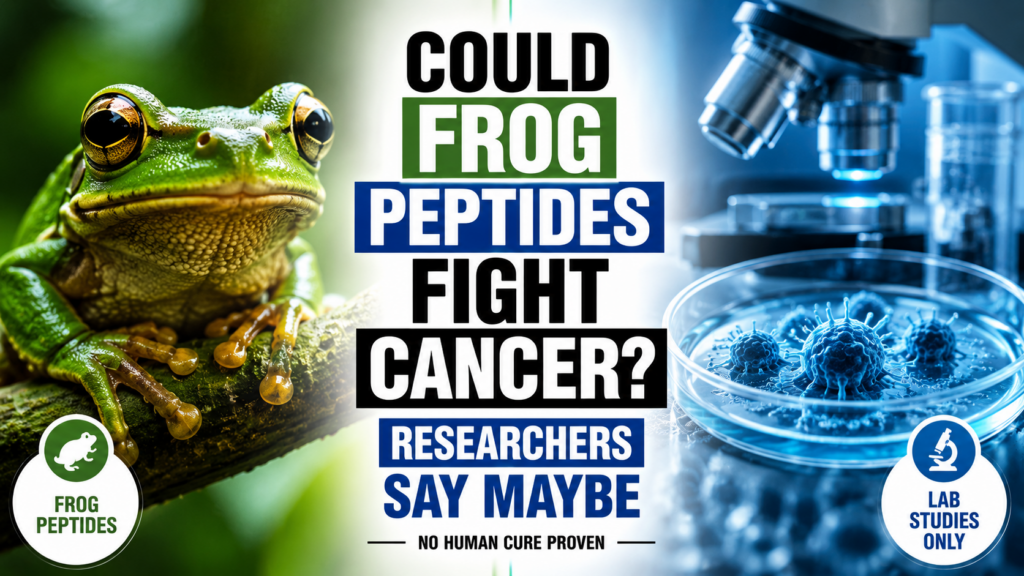
Some people online say a frog can cure cancer.
But scientists are studying tiny parts from frog skin called peptides. They want to know if those peptides could someday help make new cancer medicines. This is real research, but it is still in the early stages.
One of the best-known studies looked at a peptide called dermaseptin B2 from the giant monkey frog, also called Phyllomedusa bicolor. In lab tests, it slowed the growth of several kinds of cancer cells. In mice, it also slowed the growth of human prostate cancer tumors.
Other studies looked at caerin peptides from Australian tree frogs. Scientists found that these peptides could damage cancer cells in lab tests. A newer study said they caused a kind of cell death in some cancer cells. That sounds promising, but it still does not mean there is a cure for people.
This is the most important fact: no frog, no frog poison, and no frog ceremony has been proven to cure cancer in humans. Reviews of the research say frog peptides are interesting and may help scientists build future drugs, but there have not been clinical trials proving a cancer cure in people.
Some of the online talk is tied to kambô, which uses skin secretion from Phyllomedusa bicolor. Researchers say that secretion contains many active chemicals, but health claims around it have not been proven in clinical trials.
So, the bottom line is simple: the science is real, but the internet rumor goes too far. Researchers are studying frog peptides in labs and in animals. They are not telling people to use a frog or raw frog secretion as cancer treatment.