
If you only judged by the crowds, the shouting, and the hours-long public comment, you’d think Portsmouth City Council was deciding something life-or-death.
In reality, council wasn’t voting on a law that would change policing, override state law, or fund new programs.
So why did it pack the room?
What Was Actually Proposed
The proposed “trans sanctuary” resolution was nonbinding — meaning:
- It did not change Ohio law
- It did not override state or federal authority
- It did not create enforcement mechanisms
- It did not mandate city action
At most, it would have been:
- A statement of values
- A symbolic declaration
- A political signal — not a legal shield
In plain English:
👉 It wouldn’t have done much of anything.
So Why Did It Blow Up?
Because symbolic legislation is often more emotionally powerful than real law.
This debate wasn’t about city code.
It was about identity, fear, trust, and who feels heard.
Why Symbolic Issues Ignite Bigger Reactions
- They Feel Personal
People didn’t show up to argue municipal authority —
they showed up to talk about:
- Their kids
- Their faith
- Their safety
- Their identity
Those conversations hit nerves far deeper than potholes or zoning.
- They’reEasy to Understand (Even If They’re Misunderstood)
A nonbinding resolution is legally boring.
A phrase like “sanctuary city”?
That sounds dramatic — even threatening — to some people.
Never mind that:
- Sanctuary policies usually apply to immigration, not gender identity
- Cities don’t have the authority to nullify state law anyway
The language alone did the damage.
- National Culture Wars Get Localized
People weren’t reacting to Portsmouth policy.
They were reacting to:
- Cable news
- Social media clips
- National talking points
- Viral misinformation
City council became a proxy battlefield for a national argument.
The Irony: Big Crowd, Small Power
While the chambers were packed:
- Council couldn’t actually protect anyone from state law
- Council couldn’t actually criminalize or decriminalize anything
- Council couldn’t enforce or block enforcement
And yet…
Residents felt like this was the moment to speak.
That’s the paradox:
The less power a proposal has, the more symbolic weight people project onto it.
Compare That to Real Policy Decisions
Here’s the contrast that matters:
| Issue | Crowd Size | Actual Impact |
| Symbolic trans resolution | Standing room only | Minimal |
| Budget votes | Sparse | Millions of dollars |
| Economic development contracts | Sparse | Jobs + tax base |
| Oversight failures | Sparse | Years of fallout |
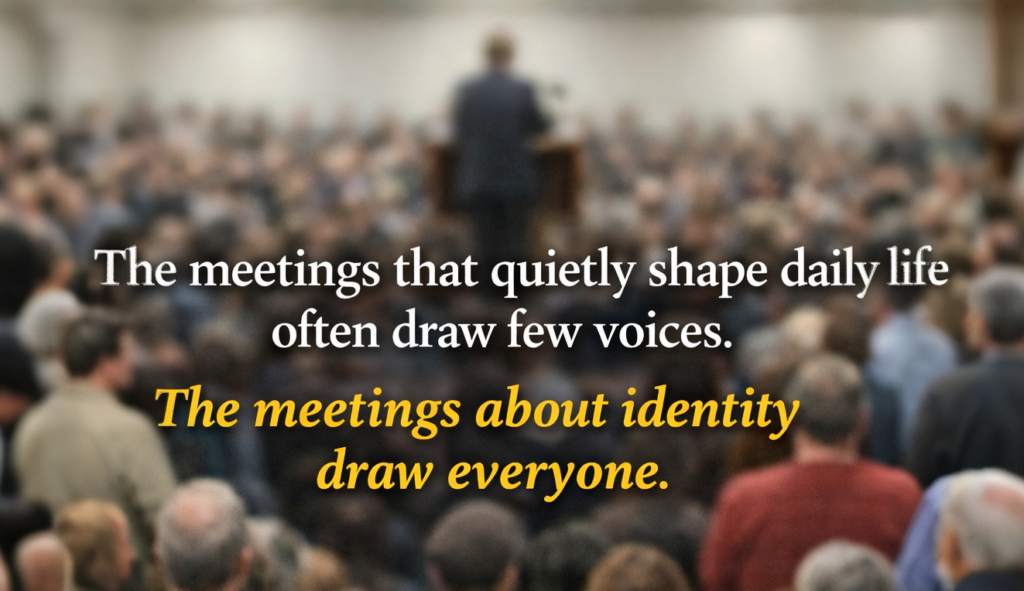
The meetings that quietly shape daily life often draw few voices.
The meetings about identity draw everyone.
The Fallout for Council
Members of Portsmouth City Council were left in a no-win situation:
- Act → accused of grandstanding
- Don’t act → accused of silence
- Debate → accused of fueling division
Some council members ultimately declined to move the resolution forward — not because they didn’t care, but because they recognized:
Council is not equipped to solve national culture wars with local symbolism.
What This Really Tells Us
This wasn’t about a piece of paper.
It revealed:
- Deep mistrust in institutions
- A hunger to be heard somewhere
- Fear that decisions are being made without the public
- A disconnect between what government can do and what people think it does
The Takeaway
The “trans sanctuary” debate showed us something important:
👉 People don’t pack council chambers for policy — they pack them for meaning.
And until local governments find better ways to:
- Explain what they can and can’t do
- Separate symbolism from substance
- Channel public energy toward decisions with real impact
…we’re likely to see this again.
Big crowds.
Big emotions.
And very little legal change.