
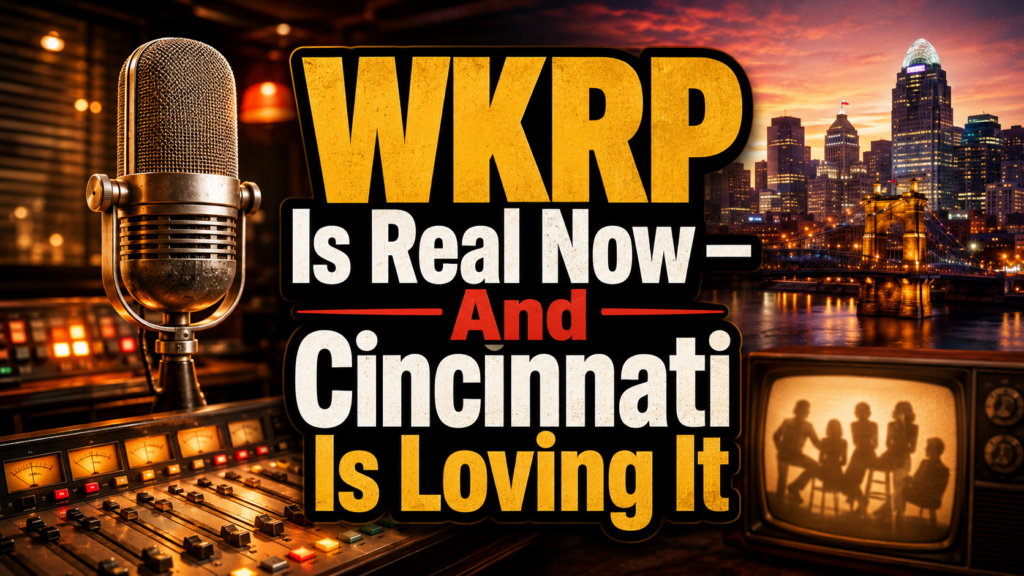
In a twist that sounds like it was dreamed up in a writers’ room and left on a shelf for 40 years, WKRP is no longer just a sitcom punchline. The famous call letters from WKRP in Cincinnati are now officially on the air, with three stations serving Cincinnati, northern Kentucky, and Dayton rebranding from The Oasis to WKRP. Station co-owner Jeff Ziesmann said listeners were “stoked,” and said the phones were quickly flooded after the switch.
The format itself is not changing much. The stations are keeping their adult-hits mix from the 1960s through the 1980s, especially the 1970s, while using the newly famous name to give the brand a bigger identity. Ziesmann has said the move is meant as a tribute to the old TV series, not a parody, and that the music already closely matched the spirit of the show.
The reboot came with a dose of showbiz flair. According to Entertainment Weekly, listeners were greeted Monday morning by Gary Sandy — the actor who played program director Andy Travis on the sitcom — after an overnight stretch that replayed the show’s theme song before the formal launch. The network now carries the WKRP name across 106.7 FM in Georgetown, Kentucky, 97.7 FM in the Cincinnati area, and 94.5 FM in Dayton and Sidney, reaching about 160 miles.
There is also a legal-radio backstory worthy of the series itself. AP reported the owners secured the call letters through a donation arrangement with a North Carolina nonprofit whose low-power station had used WKRP since 2014. Because the Raleigh outlet is a different class of station, the full-power Ohio and Kentucky signals were allowed to apply for the same call letters.
Even one of the sitcom’s stars leaned into the moment. Richard Sanders, who played Les Nessman, told AP he hoped WKRP would return to the airwaves with “more music and Les Nessman,” giving the relaunch exactly the kind of wink longtime fans would expect.
And the reaction from radio people has been openly affectionate. In comments published by Radio Ink, former Cincinnati programmer Dave Mason said he was “thrilled to be part of it,” while former GM and program director David Miller praised the station’s music format and “local feel.” For a city that spent decades loving a fictional station, the real thing appears to have landed with just the right mix of nostalgia, humor, and hometown pride.