































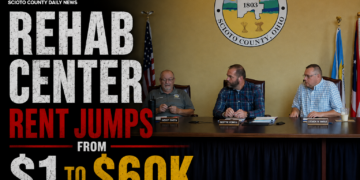















































Former Scioto County Commissioner Bryan Davis will learn his fate next week.
Davis is scheduled to appear in Scioto County Common Pleas Court at 10 a.m. Wednesday, September 16, for sentencing after pleading guilty to three felony charges in the public corruption case that has hung over county government for nearly two years.
The big question now is simple: Will Davis actually go to prison?
The answer is that he could — but the charges he pleaded guilty to do not require the judge to send him there.
What Did Davis Plead Guilty To?
Davis pleaded guilty to:
Theft in Office — Third-Degree Felony
If prison is imposed, the charge carries a possible term of 9 to 36 months. The maximum fine is $10,000.
Receiving Stolen Property — Fourth-Degree Felony
If prison is imposed, the possible term is 6 to 18 months. The maximum fine is $5,000.
Filing an Incomplete, False or Fraudulent Tax Return — Fifth-Degree Felony
If prison is imposed, the possible term is 6 to 12 months. The maximum fine is $2,500.
Ohio law establishes those prison ranges for third-, fourth- and fifth-degree felonies.
Could He Walk Out Without Going to Prison?
Yes.
That’s one of the most important things to understand about the sentencing.
The court’s plea paperwork specifically says that prison is not mandatory for any of Davis’s three convictions. It also says a prison sentence is not presumed necessary for any of them.
That means the judge has the option of imposing community control instead of sending Davis to prison.
However, that doesn’t mean Davis is likely to simply walk away without punishment.
According to reporting on the plea agreement, prosecutors have agreed to recommend a prison term when Davis is sentenced. Davis also agreed to pay approximately $67,000 in restitution.
Ultimately, though, the sentence is up to the judge.
How Much Prison Time Could He Get?
If the judge decides prison is appropriate, the most serious charge — Theft in Office — carries up to 36 months.
The other two charges carry maximums of 18 months and 12 months.
Added together, the individual maximum sentences total 66 months, or 5½ years. Reaching that number would require the sentences to be imposed consecutively rather than at the same time, something that is not automatic under Ohio law.
If the sentences run concurrently, the longest individual prison term would be three years.
And at the other end of the spectrum, because none of these charges requires prison, Davis could receive no prison sentence at all.

What Will the Judge Consider?
After accepting Davis’s guilty pleas, the court ordered a pre-sentence investigation.
That report gives the judge additional information about Davis and the offenses before deciding on punishment.
Ohio sentencing law also specifically recognizes abuse of a public office or position of trust as a factor that can make an offense more serious when that office or position was connected to the crime.
Davis’s guilty plea has already cost him his position as commissioner. He resigned following the plea, ending the unusual situation in which he had remained on paid leave while the criminal case worked its way through court.
September 16 Is the Day
Davis’s sentencing is now scheduled for 10 a.m. September 16 in Scioto County Common Pleas Court.
His wife, Lori Davis, also pleaded guilty in the case to Tampering with Evidence, a third-degree felony. Former Scioto County Economic Development Director Robert Horton and his wife remain defendants in the larger corruption case.
For Bryan Davis, however, nearly two years of court proceedings have finally reached the point where the question is no longer whether he will be convicted.
The question now is whether he will leave the courthouse September 16 — or be headed to prison.