
































































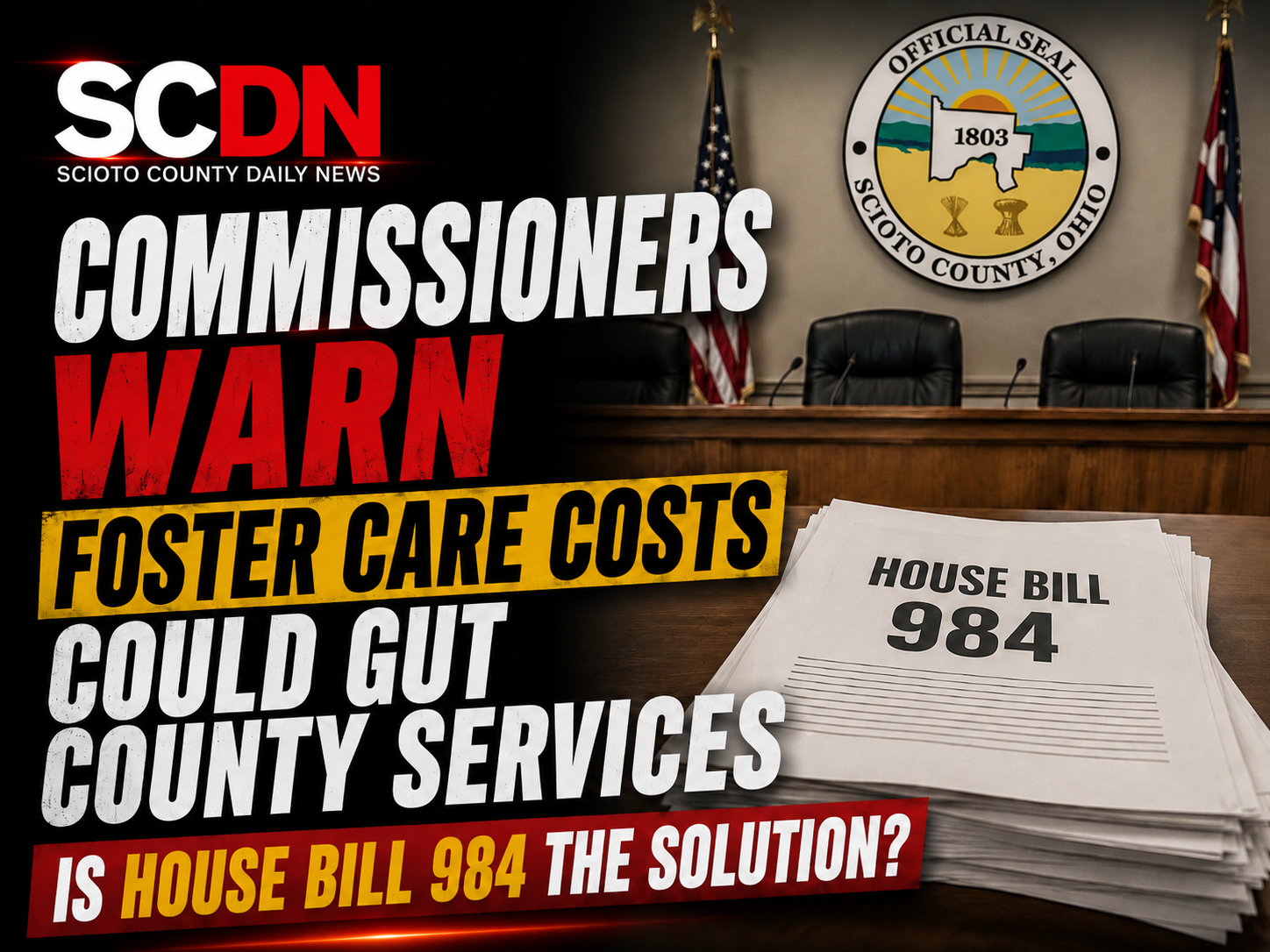
Scioto County Commissioners say the county is trapped in an impossible child welfare math problem, and unless the state steps in, local services could take a serious hit.
At their meeting, commissioners reacted to new state legislation introduced by Scioto County Representative Justin Pizzulli and Representative Darnell Brewer of Cleveland aimed at controlling skyrocketing foster care placement costs across Ohio.
The bill, House Bill 984, would require the Ohio Department of Children and Youth to set standard reimbursement rates and maximum caps for foster care placements.

For Scioto County, that cannot come soon enough.
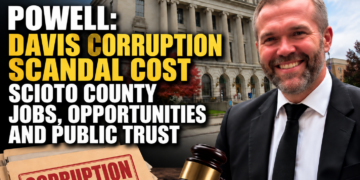
Commissioner Scottie Powell said the bill brings statewide attention to a problem local officials have been warning about for years.
“It brings a lot more attention statewide to the problem,” Powell said.
But he said money alone will not fix it.
Powell pointed out that Scioto County voters already approved a children services levy. Even with fewer children in care, the cost has continued to climb.
He said the county has cut the number of children in care roughly in half, yet the total cost has still gone up.
That is the part that makes commissioners say the system is broken.
Powell said people sometimes think this is only a Scioto County problem, but other counties are seeing the same thing. He pointed to Ross County, where he said the average daily placement cost went from about $54 to $150. He also said Vinton County’s costs have doubled.
Vinton County recently received $1 million in emergency state aid after 16 children were taken into custody in a high-profile abuse case, but Powell said that money is expected to be gone by the end of the year.
“It’s my hope it’s waking some people up,” Powell said.
Then he laid out what he called the county’s “unsolvable math problem.”
He said commissioners are left with three bad options.
They can ask taxpayers for more money, but Powell said the county already did that and it did not solve the problem.
They can take fewer children into care, but he said that is not a real option because the county cannot tell an abused or neglected child, “We can’t afford you.”
That leaves the third option: cutting other county services.
“That means less law enforcement, less county services,” Powell said.
What the New Bill Would Do
House Bill 984 would require the state to set clearer rules for what counties can be charged for foster care placements.
Right now, commissioners say counties have very little control over the rates charged by placement providers.
Powell said that is the heart of the problem.
“No one can tell me why one kid is $100, another is $300, and another is $1,000 or $1,500,” he said.
The proposed legislation would direct the Ohio Department of Children and Youth to develop a rate system for children placed with licensed providers. The department would consult with public children services agencies, providers, and county commissioners.
The bill also includes an emergency clause, saying counties are facing fiscal emergencies because of the rising cost of placing and caring for children.
Powell said a rate card committee is already looking at the issue, but he warned that if the state uses current inflated cost reports as the basis for future rates, the system could simply lock in prices that are already too high.
“We’re the first domino,” Powell said.
Commissioners Defend JFS
Commissioner Merit Smith said Scioto County Jobs and Family Services is not to blame for the crisis.
“The fact that you went from 400 kids down to 200 kids says that they’re doing something right,” Smith said.
He said JFS is doing what it is supposed to do, but the system gives counties little control over what providers charge.
“It’s just that the system is so broken,” Smith said.
Smith said the bill could help if it passes, but he cautioned that it will not solve the deeper problem.
“The problem is we’ve got a lot of kids across this state that need to be in placement,” Smith said.
He said those placements may be tied to drugs, mental health, bad parenting, or other family breakdowns that the legislature also needs to address.
Smith said even if the county received $10 million this year, it could need the same help again next year if the root problems are not fixed.
“This didn’t just happen this year,” he said.
Smith noted that federal ARPA money had helped cover some recent shortfalls, but that money is gone.
“We’ve got to find a fix to the problem, and that’s gonna have to be addressed way up the ladder,” he said.
Commissioner Will Mault agreed, saying county workers are doing their jobs.
“The folks at JFS are doing a fine job,” Mault said. “We don’t need temporary fixes. We need permanent solutions.”
Opioid Crisis Still Echoing
Smith also connected the child welfare crisis to the long-term effects of the opioid epidemic.
He said he has heard from people in education who believe many of today’s problems are tied to children born into addiction, trauma, instability, and families stretched past the breaking point.
“What we are dealing with right now is a symptom from the opioid problems,” Smith said.
He pointed to children acting out, parents unable to control them, and grandparents raising children after families were damaged by addiction.
“I don’t have the numbers to show statistically how it is,” Smith said. “But I’ve seen it. You’ve seen it.”
Local Lawmaker Pushes State Fix
Pizzulli’s involvement gives the issue a direct local connection.
The Scioto County lawmaker is co-sponsoring the bill with Brewer in an attempt to bring predictability and limits to foster care placement costs.
The legislation would not stop children from needing care. It would not erase the trauma, addiction, mental health issues, or family problems driving children into the system.
But commissioners say it could address one of the most urgent financial problems: counties being forced to pay whatever providers charge, with no clear ceiling.
For Scioto County, that may be the difference between stabilizing the budget and cutting services residents depend on.
The commissioners’ message was blunt.
The county cannot stop protecting children.
The taxpayers cannot be asked to cover endless increases forever.
And if the state does not help control placement costs, the money will have to come from somewhere else.