

















































































Independent e-commerce brands face a content production challenge that does not resolve itself as the business grows — it intensifies. Early-stage sellers manage a small product catalog with limited content requirements. Growth-stage sellers manage a larger catalog, more sales channels, more market segments, and a content calendar that demands consistent output across all of them simultaneously.
The team size rarely scales in proportion to the content demand, which means the production gap widens precisely when the brand’s visual presence matters most. AI video generation does not eliminate this gap, but it changes the economics of closing it in ways that are now practically meaningful for small operations.
The Real Cost of Inconsistent E-Commerce Visual Content
No product visuals are inconsistent with growing e-commerce brands, which is why it harms them way worse than aesthetics: 160% loss of shopper trust, before submitting an order a 40% drop in conversion rates when going to checkout page and also negative impact on free marketing with Google & social media. If shoppers experience a disparity in image and video quality across a catalog, they perceive the gap as a lack of brand trustworthiness and concern for detail, resulting in decreased purchase confidence. This damage is exacerbated by marketplace algorithms that deprioritize weak visual engagement signals, targeting low-performing content even further from the orbit of organic shoppers.
This creates a cyclical revenue life cycle: where constrained production capacity provides quality visuals to few high-demand SKUs (and minimal assets to others), driving sales on a select number of products, whilst leaving the rest of the catalog starved for visibility needed to drive revenue. This creates a vicious cycle — until you enter AI video generation, which frees up per-video production time and cost by multiple factors, providing authentic operational leverage for lean e-commerce teams.
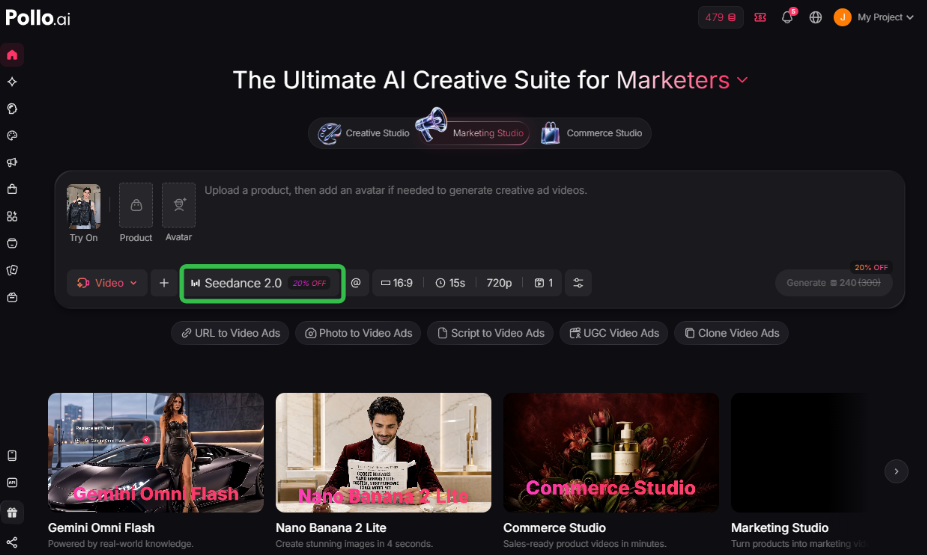
Integrated natively into the Pollo AI platform, Seedance 2.0 addresses production capacity challenges for brands seeking multi-scene, narrative quality video across extensive product catalogs. Its multi-modal reference system anchors generation to existing product photos, reference clips, and creative briefs, producing accurate product-specific output instead of generic category visuals.
Frame-level product detail stability and realistic motion rendering make output commercially viable for marketplace listings and paid advertising, not just social experimentation. The image-to-video workflow converts existing photography libraries into video assets without new production shoots, while storyboard-driven generation and bidirectional video extension enable professional-grade multi-scene ads and simple content refreshes.

Building a Content Production System, Not Just Producing Content
The operational difference between a brand that consistently produces strong visual content and one that struggles with it is almost never about tool access — it is about system design. Brands that produce content consistently have defined workflows, clear asset standards, and production schedules that treat video creation as a recurring operational function rather than a project that competes with everything else for attention.
Define Your Content Tiers
Not every product in your catalog requires the same level of video investment. Define three content tiers based on revenue contribution and strategic importance. Tier one products — your bestsellers, hero SKUs, and new launches — receive the full content stack: a multi-scene brand video, a product showcase clip, a lifestyle sequence, and a presenter-led tutorial.
Tier two products receive a product showcase clip and a lifestyle sequence. Tier three products receive a single showcase clip. This tiering system ensures that your production capacity is concentrated where it drives the most revenue impact, rather than distributed evenly across a catalog where some products will never justify the investment.
Establish Visual Identity Parameters Before Generating
AI generation produces more consistent, on-brand output when it is guided by clear visual identity parameters that translate into generation prompts. Before beginning any production session, document your brand’s visual identity in generation-ready terms: your color palette and how it should appear in lifestyle environments, the visual atmosphere appropriate for your product category, the camera movement style that reflects your brand’s character, and any visual elements — packaging, logo placement, product presentation style — that should appear consistently across all generated content. These parameters become the foundation of every prompt you write and ensure that content produced across multiple sessions maintains a coherent visual identity.
Create a Weekly Production Rhythm
Establish a fixed weekly production window — even two to three hours — dedicated exclusively to AI video generation. Use this window to work through your content backlog systematically, starting with tier one products and working down.
A consistent production rhythm produces more total content than sporadic intensive sessions, because it builds prompt-writing fluency, maintains creative momentum, and prevents the backlog from growing faster than it is addressed.
Scale Customer-Facing Video Without Adding Headcount
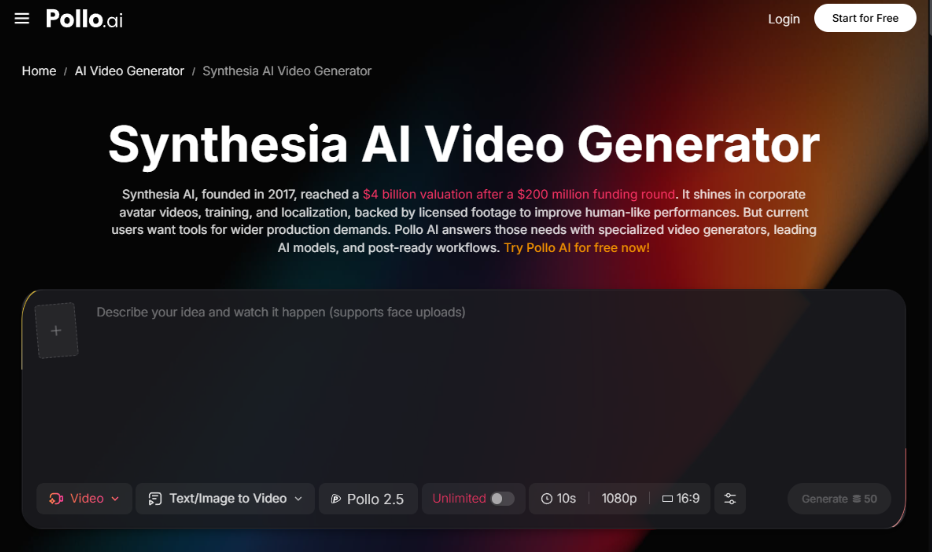
Post-purchase educational video — tutorials, usage guides, FAQs — reduces return rates and boosts customer lifetime value, but is often deprioritized due to high production overhead. Synthesia removes this barrier for e-commerce brands building customer education libraries at scale.
Its AI video assistant converts existing product documentation directly into structured presenter-led video scripts, eliminating content development bottlenecks for teams without dedicated writers. With 140+ language support and 160+ AI avatars, brands can localize content for global markets without per-language recording or dubbing costs. Centralized brand identity settings ensure consistent visual standards across all output. Combined, Seedance 2.0 on Pollo AI for product showcase and Synthesia for education content cover every video type a mature e-commerce content strategy requires.
Measuring Whether Your AI Video Investment Is Working
Content production efficiency is only valuable if output drives measurable business results. Establish clear metrics for your AI video investment before you begin producing at scale: conversion rate on product pages with new video content versus those without, engagement rate on social posts featuring AI-generated video versus static image posts, return rate on products with tutorial video support versus those without, and customer support contact volume for products with FAQ video content versus those relying on written documentation alone.
Review these metrics quarterly and use them to refine your content tier assignments — products where video is driving measurable conversion improvement should receive more production investment, while products where the impact is marginal should be deprioritized in favor of higher-impact catalog segments.
The Operational Advantage That Compounds Over Time
The brands that will build the most durable competitive advantages from AI video generation are not those that produce the most content — they are those that build the most systematic production workflows and measure their impact most rigorously. Each iteration of the workflow produces better prompts, stronger reference assets, and clearer visual identity parameters that make subsequent production sessions faster and more consistent. The operational advantage compounds in a way that sporadic, project-based video production never does.
Seedance 2.0 on Pollo AI handles the product showcase and brand advertising layer with the multi-scene narrative control and product fidelity that commercial use requires. Synthesia covers the customer education and multilingual content layer that drives retention and reduces operational costs. Build the system, measure the results, and scale what works.