
















































































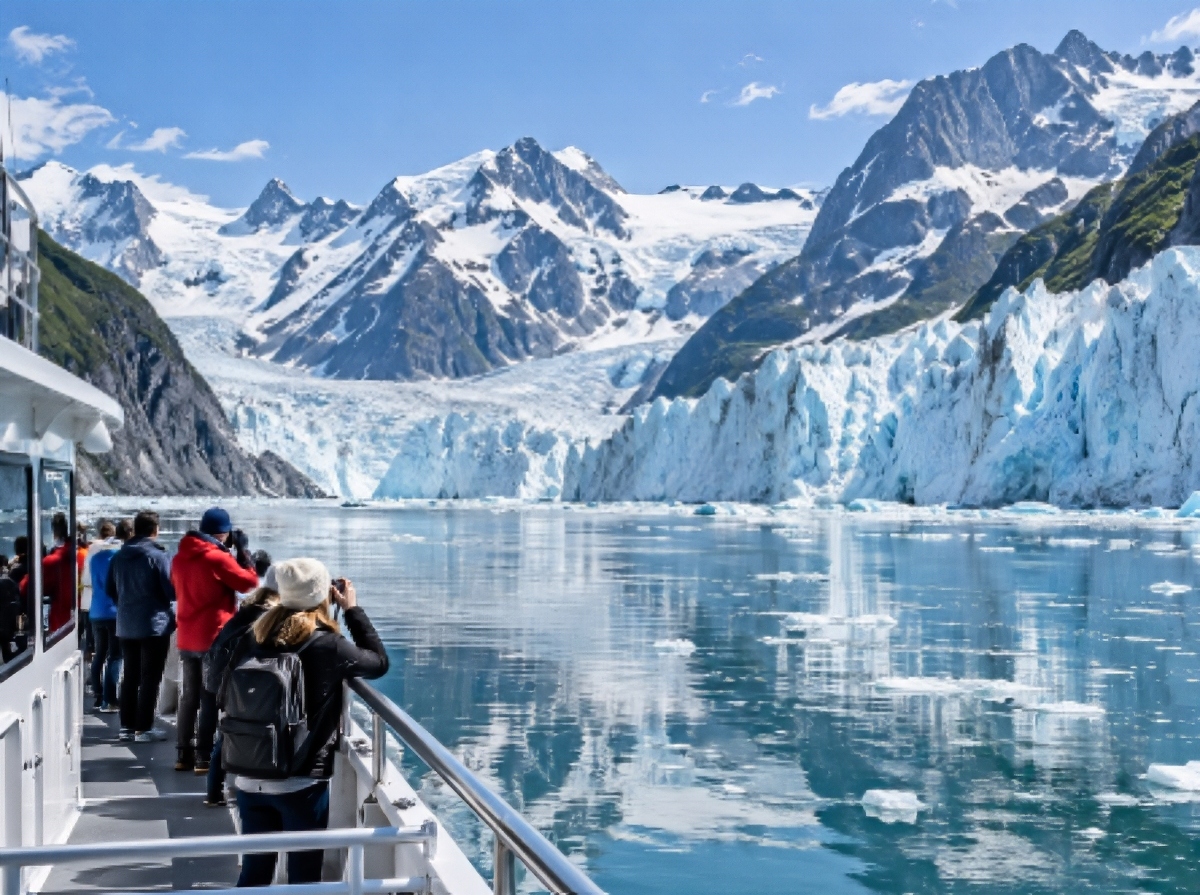
Twenty-six glaciers in one day. That’s the headline, and it’s real. But if you’ve never stood on a boat deck watching a wall of ice the size of a ten-story building crack and thunder into the ocean, no number quite prepares you for the actual experience. A Prince William Sound glacier cruise from Whittier is one of those trips that earns every superlative thrown at it, and this guide is going to tell you exactly what happens before, during, and after you board so you’re not burning the first hour just figuring out where to look.
The Sound Itself Is the Destination
Most people frame this as a glacier trip. That’s fair, but it undersells the setting. According to Travel Alaska, the official state tourism resource, Prince William Sound encompasses 10,000 square miles of protected waterways, islands, fjords, and around 150 glaciers, bounded to the east and north by the Chugach Mountains and to the west by the Kenai Peninsula. That number is staggering once you’re actually in the water and the mountains are folding in around you on every side.
The Sound has more tidewater glaciers than any other region in North America and is encompassed by the 5.4 million acre Chugach National Forest, as confirmed by the U.S. Forest Service. That’s not a backdrop, it’s the whole point. You’re moving through one of the densest concentrations of active glacial ice on the continent.
Tidewater glaciers are the specific variety that draw cruise traffic here, because they terminate directly into salt water. With a crack, a rumble and a splash, massive bergs calve from the ice and throw up huge clouds of spray. If you’re positioned on the deck when that happens, you will feel the cold air pressure drop a full second before the sound reaches you. It’s the kind of thing that sticks with you for years.
Wildlife: What’s Actually Out There
The glaciers get the brochure treatment, but the wildlife is what surprises most first-timers. The Alaska Department of Fish and Game reports that more than 220 species of birds, 30 species of land mammals, and at least a dozen marine mammal species are found in the region. On any given summer cruise, you’re realistically going to see several of those categories, not just one or two.
There’s a chance of spotting orcas year-round, as several pods live in the Sound. More common are humpback whales, which pass through while migrating in May, June, and July. Harbor seals and Steller sea lions like to hang out on the Sound’s iceberg floats and rocky islands, and sightings of otters floating along the shorelines are quite common.
Seabirds are everywhere, and I’d argue they’re underrated as a spectacle. Among the estimated 200,000 seabirds that summer in the Sound are marbled murrelets, black-legged kittiwakes, and glaucous-winged gulls. Watch the rocky cliff faces as the boat moves through the narrower passages, because that’s where the density gets genuinely dramatic.
Timing matters more than most trip-planners admit. Peak wildlife viewing aligns with July and August, when humpbacks, puffins, and salmon runs are all active simultaneously. If you’re trying to maximize the wildlife side of the trip, late July is your answer.
“The Sound is wide open for exploration by boat. Day cruises sail the sound for the best views of glaciers and marine life like seals, sea lions, and otters.”
Visit Anchorage, official travel resource for the Anchorage area
Choosing Your Cruise Length: A Practical Framework
Two cruise formats dominate the Whittier departure scene, and the choice genuinely depends on your group, not on which one sounds more impressive.
| Factor | Shorter Cruise (~3.75 hrs) | Full Glacier Cruise (~5.25 hrs)
|
|---|---|---|
| Best for | Families with young kids, motion-sensitive travelers | Photography enthusiasts, first-time Alaska visitors |
| Glacier count | Fewer stops, focused route | Up to 26 glaciers |
| Wildlife time | Adequate for most sightings | More open-water time, higher odds |
| Energy cost | Low, easy return | Plan for a quiet evening after |
| Price point | Lower adult fare | Higher adult fare, still day-trip range |

My honest take: if this is your only day on Prince William Sound, take the longer option. You won’t get a second shot at 26 glaciers in a single afternoon, and the extra two hours don’t feel long once the scenery is moving around you.
Getting There: The Whittier Tunnel Is Part of the Adventure
Whittier sits about 60 miles southeast of Anchorage, and the access point is the Anton Anderson Memorial Tunnel, a single-lane road tunnel that doubles as a rail corridor. It runs on a schedule, so your tunnel crossing time is fixed, and it dictates when you need to leave Anchorage.
The 10:30 AM tunnel is the one that feeds the longer cruise’s noon departure. Missing it means missing the boat. Set the departure alarm the night before, not the morning of, because Alaskan summer mornings with a packed car and kids tend to run 20 minutes slower than you planned.
Coach packages departing from Anchorage solve the tunnel timing entirely. They handle the logistics and include stops through the Girdwood corridor on the way down, which is worth the added cost for anyone who doesn’t love driving a narrow mountain tunnel on a schedule.
The Packing Reality Nobody Warns You About
Even in July, this cruise is cold on the water. Even in July, Prince William Sound is cold on the water. Layer with merino wool or synthetic fleece and top it with a waterproof shell. Most visitors underestimate how quickly they cool down when the boat slows near a glacier and the ambient temperature drops.
Here’s the practical version of that for a family of four: pack one more layer than you think you need, per person. Bring waterproof gloves. Bring sunscreen too, because clear Sound days with snow reflection are brutal on unprotected skin. The glaciers actively chill the air around them, and boats slow significantly near the ice faces to let passengers watch the calving action. That combination drops the perceived temperature fast.
Good binoculars are worth more than any camera upgrade. The Sound is wide, and wildlife tends to appear at distance first. Binoculars let you confirm the ID before the animal surfaces or dives again.
When to Book and What to Know Before You Do
Alaska’s cruise season has been setting visitor records. Tourism to Alaska increased 63% from 1.66 million to 2.7 million people over the past decade, with the growth largely driven by the cruise market which grew by 84%, according to McKinley Research Group 2025. Prince William Sound day cruise slots don’t have the same inventory as the big ship departures, so they fill up faster than people expect.
The season runs roughly May through early October, with the peak shoulder window from late May through mid-September covering the vast majority of sailings. The shoulder months, late May and early September, offer smaller crowds, lower prices, and often cleaner weather than midsummer. If your schedule is flexible, the first two weeks of September are genuinely underrated.
Book far enough in advance to get the tunnel time you want, not whatever’s left. When you’re ready to lock in dates, you can make a reservation with Phillips Cruises & Tours directly through their online booking page, where both cruise options and coach packages are available for the full 2026 season.
What You’ll Actually Remember
You’ll probably remember one specific moment: the boat slowing, the guide pointing, and then the ice moving. It’s not a photo moment, at least not in the way you expected. The scale defeats the camera. What you remember is the sound, the cold air, and the water turning white below the calving face.
That’s the reason a Prince William Sound glacier cruise sits at the top of so many Alaska itineraries. Plan the logistics right, dress for the weather, and the experience takes care of itself. What would your group most want to be first to spot, a calving glacier or a breaching humpback?