










































































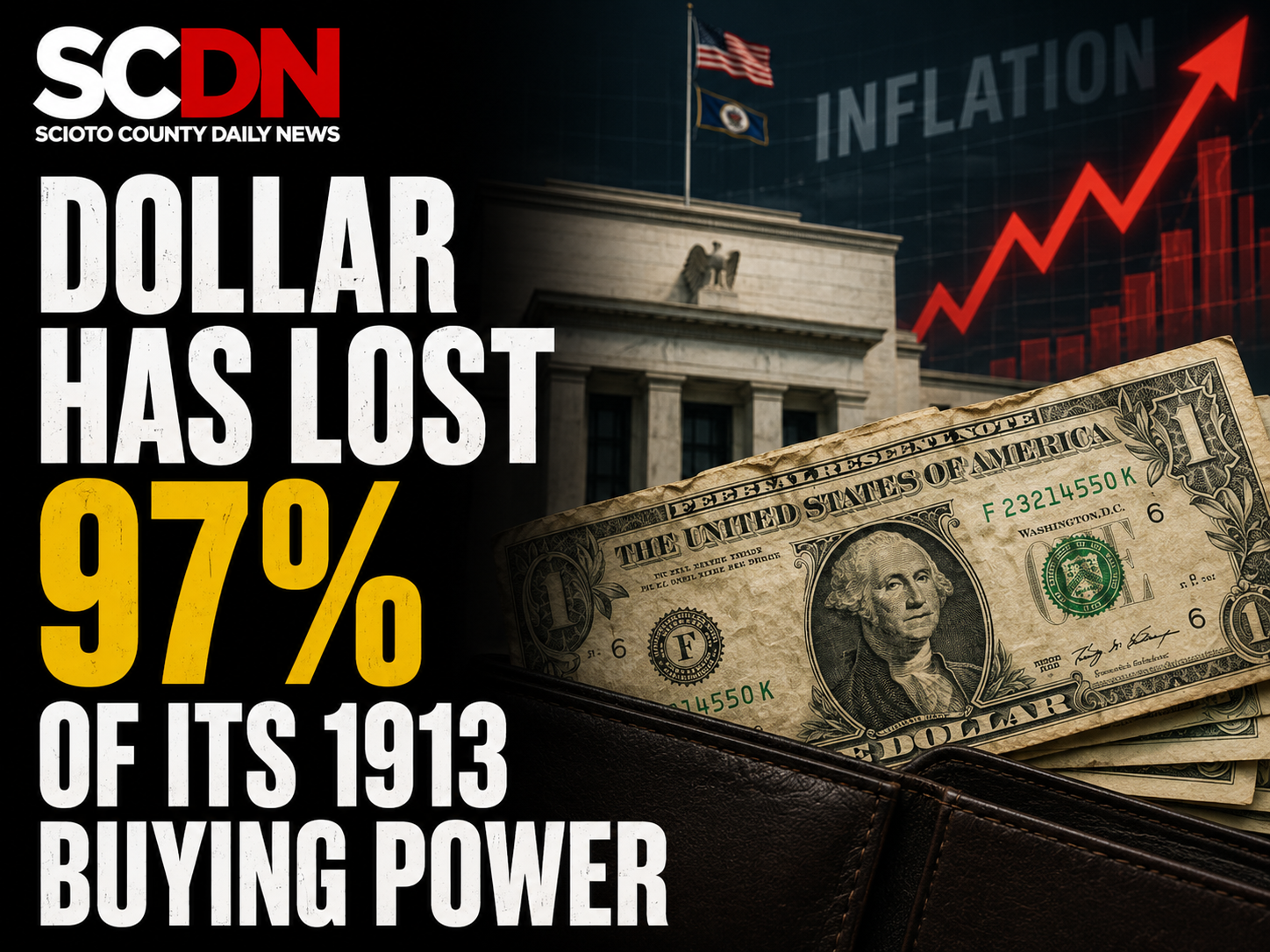
The U.S. dollar has lost roughly 97% of its purchasing power since the era when the Federal Reserve was created, but the reasons behind that decline are more complicated than the familiar claim that Washington simply “prints money.”
Consumer Price Index data from the U.S. Bureau of Labor Statistics show that the CPI stood at about 9.9 in 1913. Based on recent CPI levels, something that cost $100 in 1913 would require roughly $3,370 today to purchase an equivalent basket of goods and services.
In other words, a dollar from 1913 retains only about 3 cents of its original purchasing power.
The Federal Reserve Act was signed into law in December 1913, although the Federal Reserve did not begin full operations until 1914.
The decline is not a new observation. The libertarian Cato Institute reported more than a decade ago that the dollar had already lost more than 95% of its purchasing power since the Fed’s creation. Subsequent inflation has pushed that figure higher.
But losing 97% of purchasing power over more than a century does not mean Americans became 97% poorer.
Wages, investments, home values and productivity also increased during that period. The statistic instead demonstrates what happens to cash over long periods when prices continue rising.
That is inflation in its simplest form.
As prices increase, each dollar buys less.
For workers whose wages fail to keep pace, that means a real reduction in purchasing power. Savers can also lose ground when money held in cash or low-interest accounts earns less than the inflation rate. Retirees living on fixed incomes can face similar pressure unless their benefits receive cost-of-living adjustments.
That is why inflation is sometimes described as a “hidden tax.”
Technically, it is not a tax. Congress does not collect inflation from a paycheck or savings account.
But the result can feel similar when the same income suddenly purchases fewer groceries, less gasoline or fewer household necessities.
The causes of inflation are more complicated than one institution or political party.
One popular argument claims Congress spends beyond its means and the Federal Reserve simply prints the difference.
That is not literally how federal deficit financing works.
When the federal government spends more than it collects in taxes and other revenue, the Treasury generally borrows the difference by selling Treasury bills, notes and bonds to investors.
The federal government has run annual deficits almost continuously for decades under both Republican and Democratic administrations.
Presidents propose budgets and policies. Congress controls appropriations and taxation. Both parties have supported combinations of spending increases, tax reductions, emergency programs and borrowing that contributed to the growing federal debt.
The Federal Reserve operates separately.

It controls monetary policy, influences interest rates and can create bank reserves when purchasing financial assets. During major economic crises, including the 2008 financial crisis and COVID-19 pandemic, the Fed dramatically expanded its balance sheet by purchasing trillions of dollars in Treasury and mortgage-related securities.
Those actions increased liquidity in the financial system.
However, the Fed does not ordinarily receive a bill from Congress and print currency to pay it.
Treasury securities are initially sold through the government’s borrowing process. The Federal Reserve can later purchase securities in the open market as part of monetary policy.
The distinction matters because federal borrowing and Federal Reserve monetary policy are separate actions, although both can influence inflation.
The inflation surge following the pandemic demonstrated how several forces can collide.
The federal government approved massive fiscal assistance. The Federal Reserve maintained extremely accommodative monetary policy. Consumers suddenly changed what they were buying. Businesses faced shortages and shutdowns. Supply chains struggled to recover. Energy and commodity markets were also disrupted.
More money and stronger demand met limited supplies.
Prices climbed.
Meanwhile, Washington’s borrowing problem continues.
The Congressional Budget Office has projected a federal deficit of roughly $1.9 trillion for fiscal year 2026, meaning the government is expected to spend nearly $2 trillion more than it collects during a single year.
Federal debt held by the public is also approximately the size of the nation’s entire annual economy and is projected to continue growing under current law.
That creates another long-term problem: interest.
As debt increases, taxpayers must devote more federal revenue simply to paying interest on money Washington previously borrowed.
Calls to “audit the Fed” are also frequently misunderstood. The Federal Reserve already undergoes financial audits and oversight. Political proposals using the phrase generally seek broader congressional or Government Accountability Office access to monetary-policy decisions, rather than creation of the first audit of the central bank.
The larger story is therefore not as simple as blaming one president, one Congress or one Federal Reserve chairman.
The dollar really has lost about 97% of its 1913 purchasing power.
America really has accumulated decades of deficit spending.
And both major parties have participated.
The complicated arguments about fiscal policy and monetary policy eventually produce a very simple experience for ordinary Americans.
A dollar is worth whatever it can buy.
And over more than a century, that amount has fallen dramatically.