











































































Fifty-seven percent of proposers start their ring search more than six months before they propose. That number should stop you cold if you assumed this was a last-minute errand.
The engagement ring shopping process has changed more in the past three years than in the previous two decades combined. Couples are more informed, more collaborative, and frankly more strategic than any generation before them. If you’re heading into this process right now, knowing what the data actually says gives you a real edge over the couples who walk into a store blind.
The Collaboration Shift Nobody Saw Coming
For most of jewelry retail history, the engagement ring was a solo mission. One person, usually the proposer, handled everything in secret. That’s mostly over now.
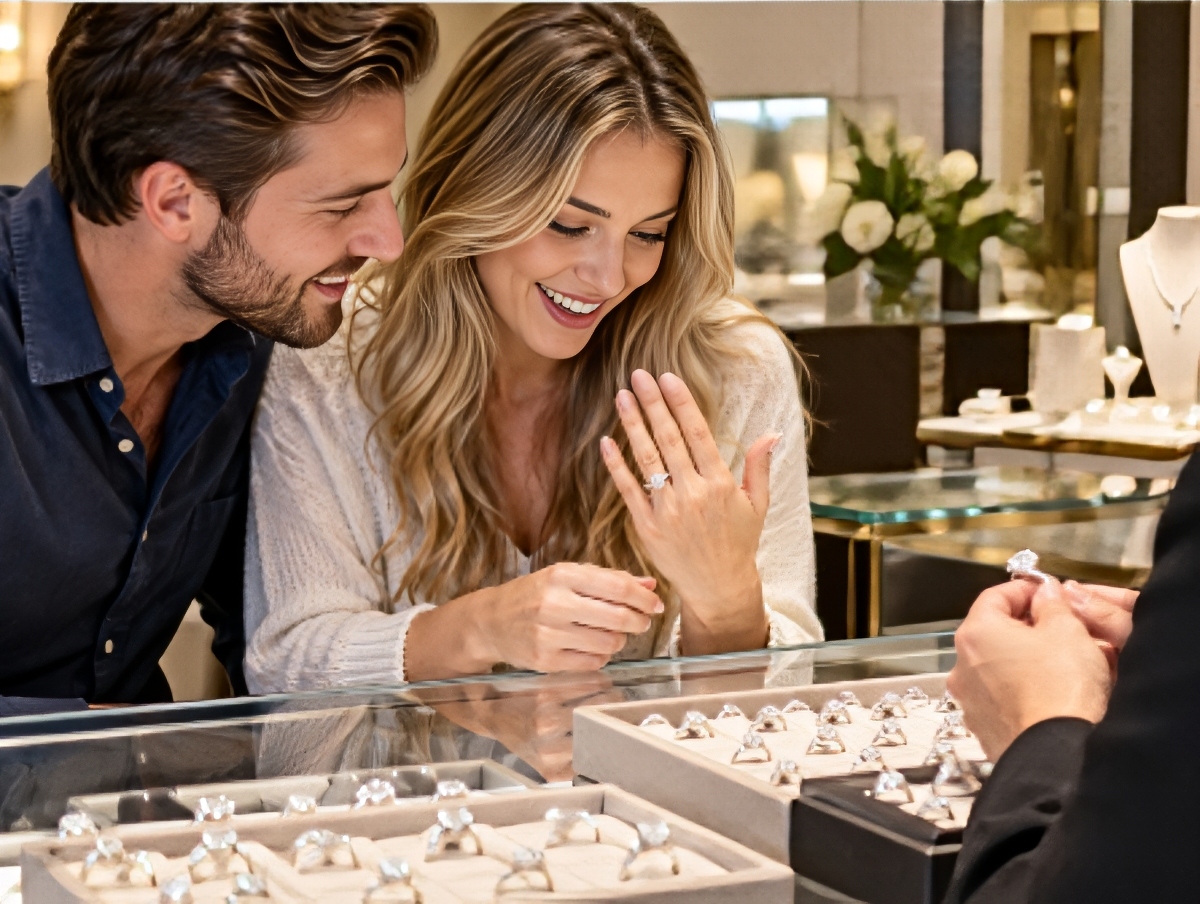
According to The Knot Real Weddings Study 2026, 79% of recipients were involved in the selection process, with one in four couples shopping together at a retailer before the proposal. That’s not a minor trend. That’s a wholesale redefinition of what “popping the question” looks like.
The reason this matters for your search: if you’re still treating the ring as a solo decision, you’re swimming against the current. Couples who shop together tend to feel more confident in their choice and are less likely to request resizes, setting changes, or upgrades after the engagement. Your partner’s fingerprints on the process don’t reduce the romance. They protect the investment.
There’s a practical framework worth using here. Think of the decision in four stages: Shape (cut and silhouette), Hardware (metal type and band style), Accent (side stones, halo, or minimalist solitaire), Price ceiling (the real number, not the aspirational one), and Experience (where and how you buy). Call it the SHAPE Framework. Run through each with your partner informally before you ever walk into a store, and you’ll cut your decision time by half.
What the Data Says About Cut, Size, and Metal in 2025
Round brilliants hold the top spot in cut popularity, but the field has compressed. The most popular diamond shape is round at 26%, closely followed by oval at 25%, with emerald, princess, pear, and marquise each holding around 8% of purchases. That near-tie between round and oval is new territory. A year ago, round had a comfortable lead.
On the metal front, something genuinely surprising is happening. Yellow gold now leads at 39%, marking a dramatic rise in popularity over the past five years, while white gold continues a gradual decline. If you’ve been assuming white gold or platinum is the only “serious” choice, you’re working from an outdated playbook.
Size is moving up too. The average total carat weight for an engagement ring reached 1.16 carats according to the Natural Diamond Trends 2025 Report, with two-carat center stones becoming increasingly mainstream as that size range shows sustained year-over-year growth.
| Design Factor | Leading Choice in 2025 | Runner-Up
|
|---|---|---|
| Diamond Shape | Round (26%) | Oval (25%) |
| Metal Type | Yellow Gold (39%) | White Gold (35%) |
| Ring Style | Center stone with accents | Classic solitaire |
| Avg. Carat Weight | 1.16 ct (Natural Diamond Trends 2025) | Growing interest in 2+ ct |
Source: The Knot Real Weddings Study 2026; Natural Diamond Trends 2025 Report, Natural Diamond Council, 2025.
How Long This Actually Takes (And Why You Should Plan for More)
Here’s something the jewelry industry doesn’t advertise loudly: 57% of proposers start their search more than six months in advance, though 63% make the final purchase within two months of the proposal. That gap is intentional. People are window-shopping, educating themselves, and building a mental shortlist long before they have any urgency.
More than half say it’s important to shop in person, with proposers visiting an average of two retailers and viewing about 10 rings before deciding. Two retailers. Not eight. Not one. Two.
That number has a useful implication for you. Pick your top two jewelers thoughtfully, not randomly. Online research can narrow your list to candidates who carry the cuts and metals you already know you want. Then use those in-person visits to confirm what you’ve already decided, not to start from scratch.
For couples in the south-central part of the country, this is especially relevant. Browsing Engagement rings in Oklahoma at a trusted independent jeweler gives you exactly the kind of curated, expert-guided experience that online-only browsing simply can’t replicate. Being able to see the ring under real light, try it on, and ask a gemologist questions in person remains something no product photo can substitute for.
“Today, couples often shop together, and the pressure to spend is therefore reduced.” — Edahn Golan, co-founder of Tenoris, quoted in National Jeweler’s 2025 State of the Majors report, noting a five-year cultural shift in the way couples approach ring purchases.

Golan’s observation cuts both ways. Yes, shared decision-making softens the budget pressure. But it also raises the stakes on fit. When both people are invested in the choice, a compromise ring nobody loves is a worse outcome than it would have been with a surprise that missed the mark. You’re aiming for genuine alignment, not just agreement.
The Lab-Grown Conversation You Need to Have
You’re going to face this question at almost every jeweler you visit, so better to settle it before you walk in the door. Lab-grown diamonds now represent a major share of the market. They’re physically identical to natural diamonds and cost significantly less per carat. Natural diamonds carry rarity value and, for some buyers, an emotional or heirloom quality that matters to them.
Neither option is wrong. The honest answer is that this is a values question, not a quality question. Decide together which matters more to you: a larger stone within a tighter budget, or the long-term rarity value of a natural diamond. Write down the answer before your first store visit. Your jeweler will serve you better when you know your own answer.
A Practical Checklist Before You Visit Any Store
- Run through the SHAPE Framework with your partner. Even rough answers help.
- Set a real budget ceiling. The average spend in 2025 varies widely by source, so anchor to your own finances, not someone else’s average.
- Decide your lab-grown vs. natural stance before you walk in.
- Know your partner’s ring size or bring a ring they already wear for the jeweler to measure.
- Ask every jeweler about their resize and upgrade policies up front.
- Plan at least two store visits. Use the first to orient, the second to decide.
One more thing worth saying plainly: no amount of online research replaces the moment you hold a ring under a loupe and see the light play inside the stone. The data, the frameworks, the trend reports — they all exist to get you to that moment with confidence. The rest happens in person.
Where will your search take you?