














































































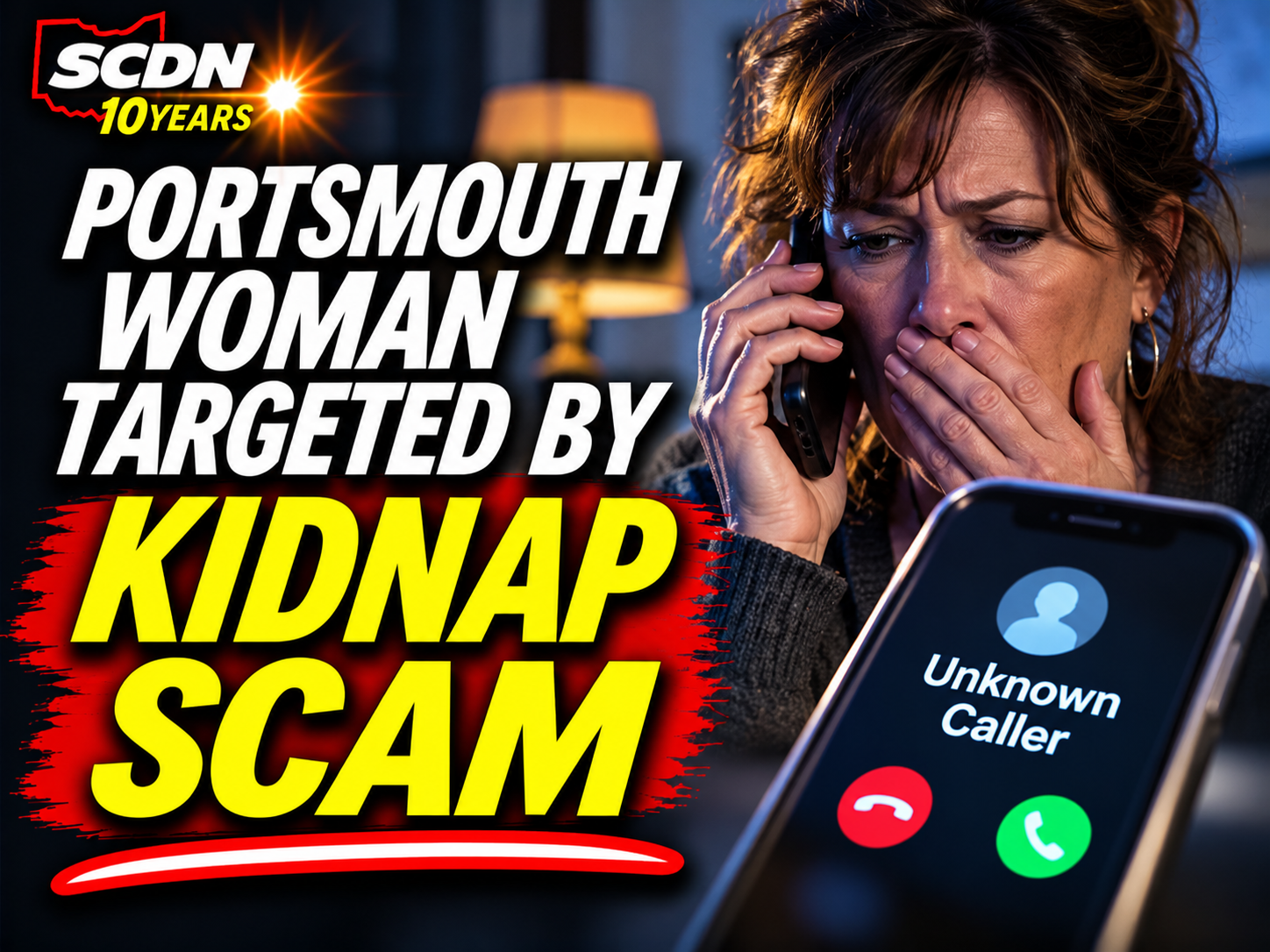
A terrifying phone call claiming a woman’s daughter and granddaughter had been kidnapped quickly started looking like a scam when the supposed kidnappers asked for a Walmart gift card.
Portsmouth Police were flagged down near Aldi on Gallia Street by a woman who was still on the phone with an unknown man claiming he had kidnapped her daughter and granddaughter.
The woman told officers her daughter lives in Adamsville, Ohio.
Police contacted the Muskingum County Sheriff’s Office and asked deputies there to conduct a welfare check.
Then came the giveaway.
The caller began asking for a Walmart gift card.
Officers gathered information for a report.
The incident closely matches a scam law enforcement agencies call virtual kidnapping — a frightening variation on the longtime grandparent or family-emergency scam.

No Kidnapping Required
In a virtual kidnapping scam, nobody has actually been abducted.
Instead, scammers call a parent, grandparent or other relative and claim a loved one is being held hostage. They may threaten violence, claim the victim has been injured or even put someone screaming or crying in the background.
The goal is panic.
The FBI says the scheme works by creating enough fear and urgency that victims send money before they have time to verify whether their relative is actually in danger.
Scammers often try to keep victims on the phone so they cannot independently call the supposed kidnapping victim or another family member.
Gift Card Request Is a Giant Red Flag
In the Portsmouth incident, the request for a Walmart gift card was an especially strong warning sign.
The Federal Trade Commission says anyone demanding payment through gift cards should be treated as a scammer. Once the card number and PIN are handed over, the money can be difficult or impossible to recover.
Scammers favor gift cards, wire transfers, cryptocurrency and other payment methods because they can move the money quickly and make recovery difficult.
A real kidnapper demanding ransom is not likely to ask Grandma to head to Walmart and buy a gift card.
How They Make It Sound Real
Family-emergency scammers do not always start with much information.
Sometimes they use names, relationships and details pulled from social media.
Other times, the victim accidentally provides the information.
The FBI has described cases where a caller played the sound of a woman screaming and waited for the person answering the phone to say something like, “Sarah, is that you?”
The scammer now has the daughter’s name and can build the rest of the story around it.
More sophisticated versions can use photographs taken from social media as fake “proof of life.” The FBI has also warned that criminals can alter publicly available images to make the kidnapping claim look more convincing.
What Should You Do?
The first rule is simple:
Do not send money immediately.
Try to contact the supposedly kidnapped person directly using a phone number you already know.
If you cannot reach them, call another relative, friend, employer or school that may be able to verify where they are.
Do not rely on a number supplied by the caller.
If you speak with the supposed victim during the call, ask a question only that person would know. The FBI also recommends families consider establishing a private code word for emergencies.
And don’t volunteer information. If the caller says, “We have your granddaughter,” don’t respond with, “Do you mean Emily?”
Make the caller provide the details.
Call Police
If someone tells you a loved one has been kidnapped, involving police immediately is exactly the right move.
That’s what happened in this case.
Instead of rushing to buy a gift card, the women flagged down Portsmouth officers while the supposed kidnapper was still on the phone.
Police could then contact law enforcement where the daughter actually lived and request a welfare check.
That takes away the scammer’s biggest advantage:
keeping a frightened family member isolated long enough to get the money.
The FBI says suspected virtual-kidnapping attempts can also be reported to local law enforcement and the Internet Crime Complaint Center at IC3.
The biggest warning sign may be the simplest one.
If someone says your loved one is in terrible danger — but the solution is buying them a Walmart gift card — don’t pay.
Start checking.