



































































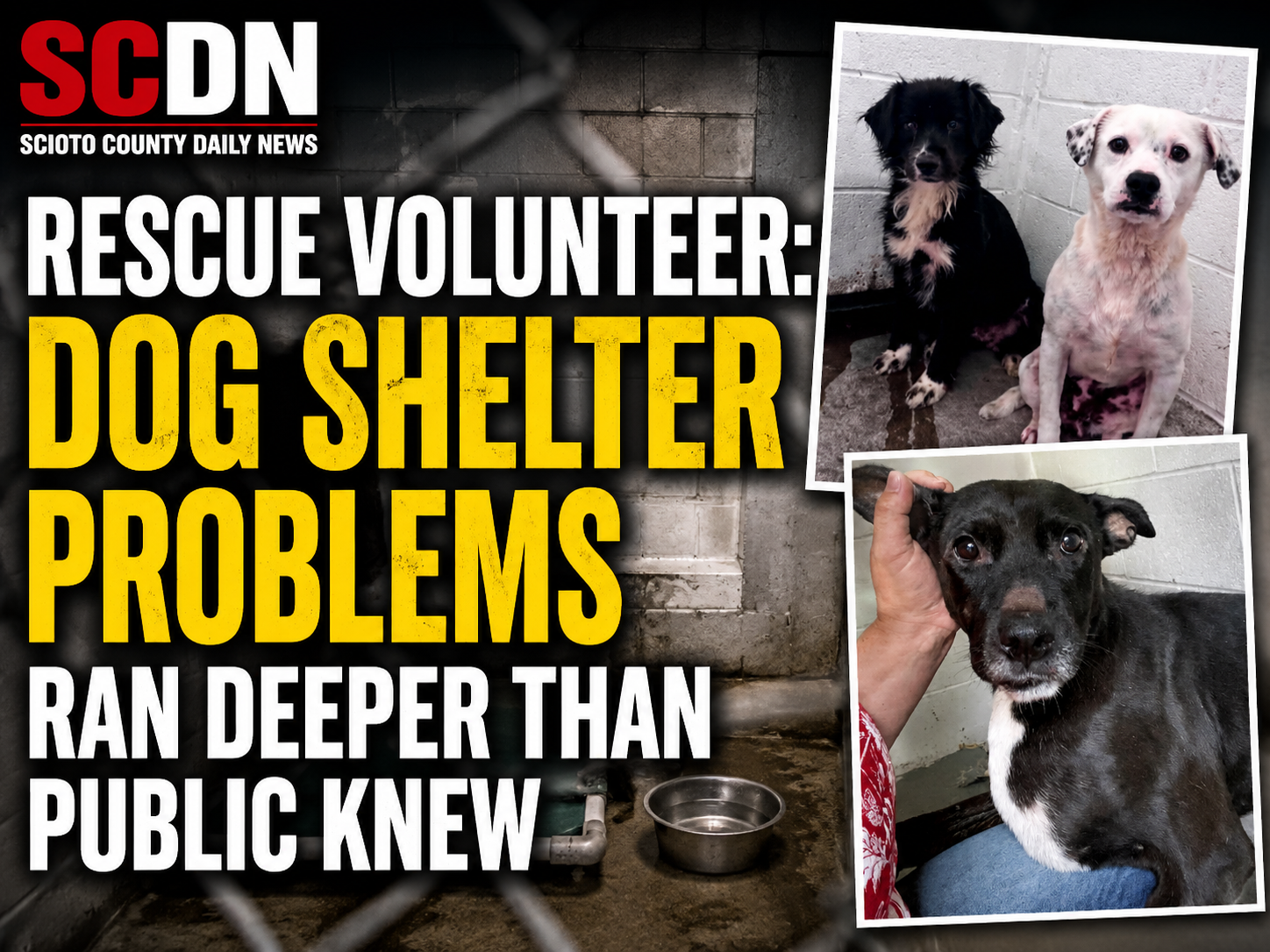
The Scioto County Dog Shelter is undergoing yet another reset.
County commissioners are recruiting for a newly combined Dog Warden/Director position. Scioto Hounds has stepped in with vaccines, food, equipment and other assistance. New volunteers are being recruited, and commissioners have publicly discussed everything from nonprofit partnerships to potentially shifting dog warden duties to the Scioto County Sheriff’s Office.
Those are signs of progress after months of turmoil.
But a longtime local rescue volunteer says that as Scioto County looks toward the future, officials shouldn’t lose sight of just how bad things became before the lid finally blew off the troubled shelter.
Tiffany Pistole, a volunteer with Rico Pet Recovery since 2020, says she has watched the shelter go through periods when rescues wanted little to do with it, followed by a dramatic turnaround when former Dog Warden Heather Stevens and recently resigned kennel technician Shanna Donini began rebuilding relationships with outside organizations.
Now both women are gone, and Pistole says she fears some of the same problems that drove rescues away in the past could return.
“I think the Shelter has a lot of potential to be a great facility,” Pistole said. But she believes that will require the right leadership, written procedures and accountability for how those procedures are followed.
From 3 Dogs to 46
Pistole provided SCDN with Rico Pet Recovery’s annual numbers for dogs pulled from the county shelter.
The organization took just three dogs in 2021 and six in 2022. That jumped to 17 in 2023, the year Stevens began working at the shelter, and then soared to 46 in 2024. Rico pulled another 19 dogs in 2025 and six during the first six weeks of 2026.
Since then, Pistole says she has taken only one.
Stevens resigned earlier this year following a bitter dispute with county officials. Donini recently followed her out the door, telling SCDN that she stayed as long as she did because she feared what would happen to the dogs without her.
“I’ve just been keeping them afloat and it’s time to turn the boat over,” Donini told SCDN.
Pistole says the numbers demonstrate something important that can get lost amid arguments over personalities at the shelter: when rescuers trusted the people working there, more dogs got out.
She says Stevens and Donini regularly contacted her when they had difficult dogs, overcrowding or animals desperately needing rescue placement.
“What happens now that both advocates have stepped aside?” Pistole asked.
The Dog That Waited Too Long
Perhaps the most troubling case Pistole described involved a dog called Baby Girl.
Pistole says she first noticed the dog limping during a visit to photograph and walk shelter dogs in the summer of 2025. What initially appeared to be a problem with her leg developed into a visibly massive tumor.
Pistole alleges shelter employees raised concerns about the dog’s deteriorating condition with the Shelter Director, but the dog was not promptly taken for veterinary treatment or released to rescue.
Eventually, Pistole says Stevens took action and asked whether Rico Pet Recovery could help.
The rescue couldn’t immediately take Baby Girl, so Pistole began raising money herself. Community members came up with approximately $1,000 for surgery, and Pistole planned to bring the dog home as a hospice foster.
She never got the chance.
According to Pistole, veterinarians discovered the cancer was far more extensive than anticipated, including involvement around the dog’s jugular and spread into a lung. Baby Girl died during surgery.
Pistole had contacted Commissioner Scottie Powell before the surgery, asking why the dog had apparently remained at the shelter for weeks as the mass grew.
“How can we make sure dogs are not needlessly suffering while in possession of the county?” she asked in the message.
Pistole says she did not receive a response.
SCDN has reviewed the message and photographs supplied by Pistole, including images showing a substantial mass on Baby Girl.
Her allegations about who knew what and who made or refused particular treatment decisions are Pistole’s account and should not be confused with an independent finding against any individual employee.
Parvo, Vaccines and a Rescue Transport Shutdown
Pistole’s concerns weren’t limited to one sick dog.
She says puppies at the shelter became sick with parvovirus and alleges that some died while others were euthanized.
That concern takes on additional significance because an outside organization subsequently raised its own alarm.
Stop the Suffering notified rescue partners that there had been several parvo incidents at the Scioto shelter and said it had not initially been informed about them. The organization stopped putting Scioto County dogs on its transport system, citing concerns about vaccination, quarantine, cleaning and other safety procedures.
Its executive director wrote that, based on her assessment, shelter leadership did not adequately train staff and that standard protocols appeared to be lacking in areas including vaccine management, quarantine and cleaning.
The organization recommended that dogs coming from Scioto County be quarantined and said it could not risk compromising the safety of other animals aboard its transports.
That was a potentially devastating development for an overcrowded rural shelter that depends heavily on rescues to move dogs out.
Donini’s messages to Pistole also show just how much of that work happened behind the scenes. In one exchange, Donini pleaded for help with two frightened dogs that had been at the shelter for weeks. In another, she sought placement for a group of dumped puppies.
Pistole says some of the dogs Donini was trying to save were later euthanized.
Ranger’s Trip to the Vet
Another dog named Ranger illustrates Pistole’s concerns about routine medical care.
While walking Ranger, Pistole noticed he had loose stool. She says she collected a sample herself and took it to Shawnee Animal Clinic.
A veterinary test report supplied by Pistole shows that Ranger tested positive for multiple parasites, including hookworm, coccidia and roundworm. The test recorded a hookworm count of 443.
Pistole says the clinic was shocked by the dog’s condition.
She also says rescuers have purchased flea and tick medication for shelter dogs themselves because the county wasn’t supplying it.

To Pistole, those aren’t luxuries. They’re examples of outsiders filling holes in a system responsible for animals entirely dependent upon it for their care.
Then There’s Billie Jean
Pistole also raised questions about one of the shelter’s longest-term residents, a dog named Billie Jean.
She says the dog has been housed at the facility for at least four years and has become increasingly aggressive while spending much of her time separated from the other animals in a back room.
Pistole described one frightening encounter while she was walking another shelter dog.
She said she was inside the fenced area when she realized Billie Jean was loose. Pistole says she was able to back herself and the dog she was walking into the patio area and shut the door before Billie Jean reached them.
Pistole says she doesn’t know what Billie Jean’s current weekend care schedule looks like or how frequently the dog is exercised.
Her account raises larger questions about what long-term plan exists for an animal that may be unsafe for conventional adoption: How frequently is Billie Jean exercised and evaluated? Has she received a professional behavioral assessment? What enrichment does she receive? And what is the long-term plan for her?
SCDN has not independently established how long Billie Jean has been at the shelter or her current care routine.
Not Just Criticism
Pistole isn’t arguing that nothing positive is happening.
Quite the opposite.
Scioto Hounds has emerged during the crisis as an increasingly active partner for the county shelter. The nonprofit has helped secure vaccines, thousands of pounds of dog food and assistance moving animals to rescue. It has also worked with commissioners on improvements to the non-climate-controlled portion of the facility, including ventilation and air movement.
Commissioners have praised the organization for stepping up as part of the solution rather than simply criticizing the county.
There has also been a push for additional volunteers, something desperately needed at a facility where dozens of dogs can require feeding, cleaning, exercise and attention every day.
And now commissioners have advertised a combined Dog Warden/Director position that would put shelter management and dog-law enforcement under one job.
The lengthy job description reads almost like a checklist of the shelter’s recent pain points. The person hired would be responsible for staff supervision and training, animal health, public safety, budgeting, facility maintenance, rescue relationships, policies and procedures, bite investigations, emergency calls and ensuring dogs are properly fed and cared for.
It’s an enormous job.
Where Does the Shelter Go From Here?
Pistole doesn’t want the shelter to fail.
She wants the opposite.
She points to dogs like Stevie, who arrived at the shelter in terrible condition before eventually making it into rescue. Pistole named the dog after Heather Stevens because she says Stevens knew she could call her when a difficult case needed someone willing to take a chance.
Stevie recovered and was eventually adopted.
That’s what Pistole believes the shelter can accomplish when employees, volunteers and rescue organizations work together.
But she also doesn’t want the optimism surrounding Scioto Hounds, new volunteers and another restructuring to erase what happened before.
The county has endured repeated resignations, difficulty getting dog wardens to emergency calls, overcrowding, complaints about veterinary care, a breakdown in rescue relationships, parvo concerns and questions about training and management.
Now comes another attempt to rebuild.
There are people willing to help. Scioto Hounds is helping. Rescuers are still out there. Volunteers are being recruited. Commissioners have acknowledged the problems and are looking at structural changes.
For Pistole, however, fixing the building and filling vacant jobs is only part of the answer.
The larger challenge is creating a system where the welfare of a dog doesn’t depend on whether the right employee happens to be working that day, whether a volunteer notices something is wrong, or whether someone outside the county government is willing to raise the money and make the call for help.
Because once those people walk away, Pistole’s question remains:
What happens to the dogs?