














































































Pain, dizziness, a pounding heart, stomach discomfort, breathlessness, or an unusual sensation can capture your attention immediately. Sometimes the sensation is followed by a frightening interpretation: “Something is terribly wrong,” “I’m losing control,” or “Something bad is about to happen.”
That interpretation activates the body’s threat system. The resulting physical changes can intensify the original sensation, reinforcing the belief that danger is present:
Pain or bodily sensation → threat interpretation → autonomic activation → stronger sensations → greater fear
This is sometimes called a fear, panic, or body–anxiety feedback loop. The symptoms are real even when the threat system is reacting to a false alarm.
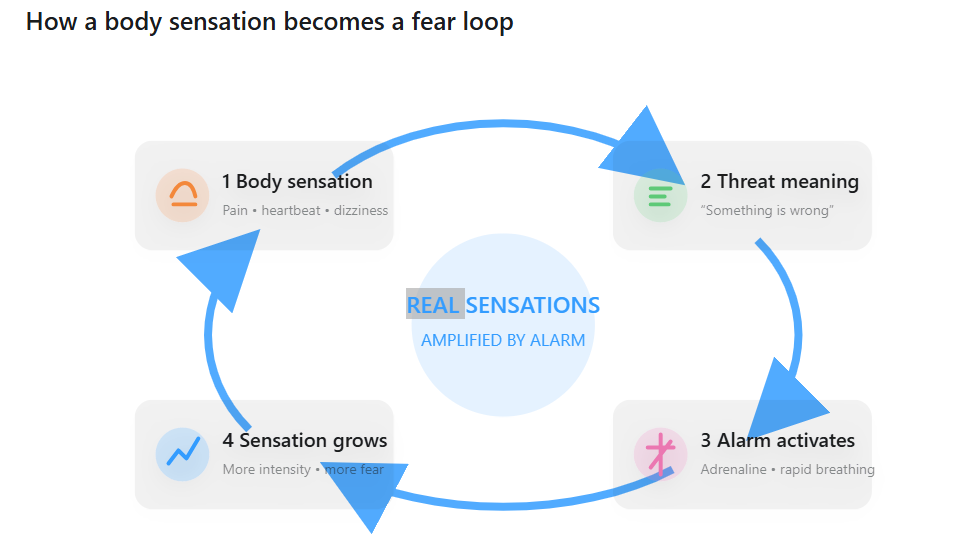
How the loop works
1. A bodily sensation begins
The process may start with pain, fatigue, a headache, muscle tension, indigestion, nausea, skipped heartbeats, breathlessness, or another internal sensation.
Sensory nerves continuously report conditions in the body to the brain. The vagus nerve carries much of the information coming from internal organs, while spinal and trigeminal nerves carry most body pain and headache-related information.
2. The brain evaluates the sensation
The brain does not merely receive sensory data—it interprets it. It asks, usually outside conscious awareness:
- Is this familiar?
- Is it dangerous?
- Do I need to act?
- Have I felt this before during a frightening event?
Context matters. Poor sleep, persistent pain, illness, chronic stress, previous panic attacks, trauma, caffeine, and uncertainty can make the brain more likely to interpret an ambiguous sensation as dangerous.
3. The threat system activates
When the brain detects possible danger, the sympathetic branch of the autonomic nervous system mobilizes the body. Adrenaline and related stress responses can produce:
- Faster or more forceful heartbeats
- Rapid or shallow breathing
- Chest or throat tightness
- Sweating, trembling, or chills
- Dizziness or lightheadedness
- Tingling or numbness
- Nausea or abdominal discomfort
- Muscle tension and increased pain
- Heightened alertness and racing thoughts
These changes are designed to help you confront or escape danger. During a false alarm, however, they become additional sensations to worry about.
4. Attention narrows
Your attention may turn inward as you check your pulse, breathing, balance, pain, or thoughts. This is understandable, but close monitoring makes subtle sensations easier to notice.
The mind may also produce intrusive thoughts:
- “What if this gets worse?”
- “What if I pass out?”
- “What if the doctors missed something?”
- “What if I lose control?”
An intrusive thought is not a prediction, intention, or fact. It is mental activity generated by a brain searching intensely for possible danger.
5. The loop reinforces itself
The stronger sensations seem to confirm the threatening interpretation. Fear rises, the body mobilizes further, and the sensations become more intense.
This does not mean the symptoms are imaginary. It means that a real physiological alarm response may be amplifying the original symptom.
What this may mean for you
This framework could explain why pain or another bodily sensation is sometimes followed by anxiety, intrusive thoughts, or a sense of impending doom. It does not, by itself, prove that anxiety caused the original symptom. A medical condition and a fear response can also occur together.
The important distinctions are:
- The vagus nerve’s large number of incoming fibers is normal and does not mean it is overloaded.
- Most body pain travels through spinal sensory pathways; most headache pain involves trigeminal and upper-cervical pathways.
- Vagal signals contribute to awareness of internal conditions and may influence nausea, heart-rate sensations, breathing, and emotional state.
- The complete experience arises from interactions among sensory nerves, the autonomic system, pain-processing networks, and the brain’s threat circuits.
- A sensitive alarm system is not a personal failure. It is a protective system responding too strongly or too readily.
You should not automatically label every episode as anxiety. New, severe, or changing symptoms deserve appropriate medical evaluation. Once urgent and treatable causes have been considered, understanding the feedback loop can make the sensations less mysterious and easier to manage.
What to do during an episode
1. Check briefly for emergency signs
Seek emergency help for symptoms such as:
- New or severe chest pressure, particularly with sweating, nausea, or pain spreading to the arm, jaw, shoulder, or back
- Unexplained difficulty breathing, fainting, or bluish lips
- Sudden weakness or numbness on one side, facial drooping, confusion, or difficulty speaking
- A sudden “worst-ever” headache
- A severe headache with weakness, loss of consciousness, seizure, fever, or stiff neck
- An immediate risk that you might harm yourself or someone else
Do not try to breathe through or psychologically reinterpret a possible emergency. Review the National Institute of Neurological Disorders and Stroke headache warning signs and seek immediate care when appropriate.
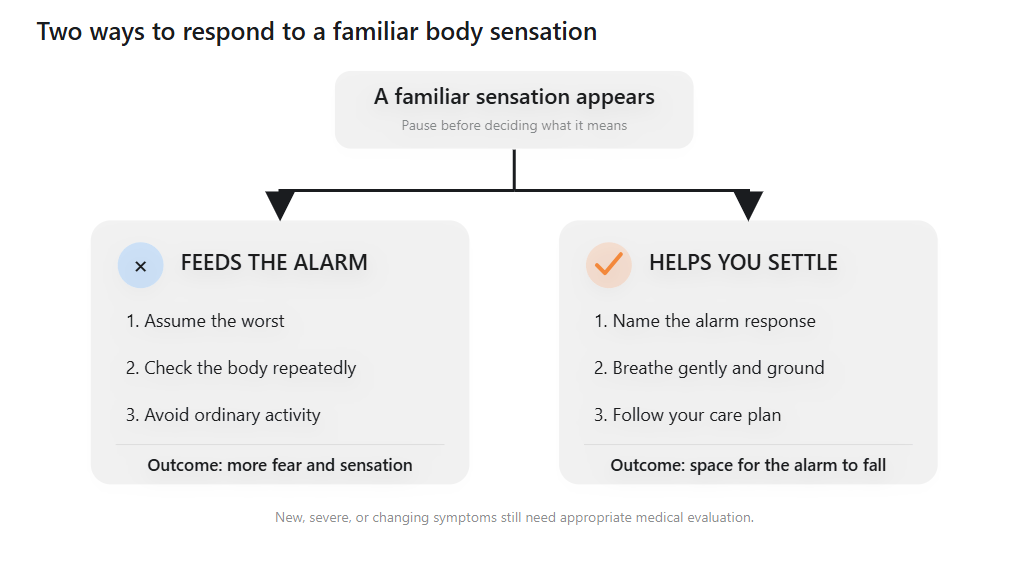
2. Name the process
If no emergency warning signs are present and the episode resembles a previously evaluated pattern, use a grounded statement:
“I am noticing a body–fear loop. The sensations are real, but the intensity may be coming partly from my alarm system. I do not need to solve every sensation this instant.”
The goal is not to guarantee that nothing is wrong. It is to replace catastrophic certainty with a more balanced explanation.
3. Slow the breathing gently
Use comfortable, quiet breaths rather than repeated deep breaths, which can worsen lightheadedness.
Try inhaling normally and allowing the exhale to be slightly longer—for example, four seconds in and six seconds out—for one or two minutes. Stop if this makes you feel worse.
4. Shift attention outward
Identify:
- Five things you can see
- Four physical contact points you can feel
- Three sounds you can hear
- Two things you can smell
- One ordinary activity you can do next
This is not an attempt to suppress the sensation. It reminds the brain that the sensation is only one part of the present environment.
5. Reduce checking and reassurance rituals
Repeatedly checking your pulse, searching symptoms online, examining your body, or asking others for reassurance may provide short relief while teaching the brain that the sensation required an emergency investigation.
Unless a clinician has instructed you to monitor something, consider delaying the next check for 10–15 minutes. Gradually lengthen that interval.
6. Allow the wave to decline
Autonomic activation usually rises, peaks, and falls. Fighting every symptom can keep attention locked onto it. A more useful stance is:
“This is uncomfortable, and I can let it be present while my nervous system settles.”
Steps to take between episodes
Arrange a medical assessment
Discuss recurring pain, headaches, palpitations, breathlessness, or changes in your usual pattern with a primary-care clinician. A clinician can evaluate possible contributors such as migraine, medication effects, sleep problems, anemia, thyroid conditions, heart-rhythm disturbances, infection, or musculoskeletal and neurological conditions.
Bring a concise symptom record containing:
- When episodes begin and how long they last
- The first symptom you notice
- Pain or headache location and quality
- Associated heart, breathing, stomach, vision, or neurological symptoms
- Sleep, hydration, meals, caffeine, alcohol, and medications
- What you were doing and thinking immediately beforehand
- What reduces or worsens the episode
The record should support clinical evaluation, not become continuous body surveillance.
Address the anxiety component directly
If episodes recur, lead to avoidance, or interfere with daily life, ask about assessment for panic disorder, health anxiety, generalized anxiety, obsessive-compulsive disorder, trauma-related symptoms, or depression.
Cognitive behavioral therapy can help change catastrophic interpretations and safety behaviors. Exposure-based approaches can teach the brain that certain sensations are uncomfortable but tolerable. Exposure and response prevention is especially relevant when intrusive thoughts and compulsive reassurance or checking are prominent.
Medication may also be appropriate, but that decision should be made with a qualified clinician.
Support the nervous system consistently
Helpful foundations include:
- Regular sleep and wake times
- Regular meals and adequate hydration
- Gradual, medically appropriate physical activity
- Reduced caffeine or stimulants if they worsen symptoms
- Limited alcohol and recreational drug use
- Scheduled relaxation instead of using it only during crises
- Continued participation in ordinary activities rather than progressively avoiding them
A practical personal plan
Complete these statements and keep them somewhere accessible:
My common first sensations:
My usual frightening interpretation:
My emergency warning signs:
My more balanced explanation:
The grounding or breathing method I will use:
The checking or reassurance behavior I will delay:
The clinician or support person I will contact:

The central message
A body–fear loop is a real interaction between sensation, interpretation, attention, and autonomic physiology. It can make pain and other symptoms feel more intense and urgent. Recognizing the loop does not mean dismissing your health or declaring that everything is psychological. It means responding in two sensible ways: obtaining appropriate medical evaluation and learning how to prevent the threat system from unnecessarily amplifying the experience.
With assessment, practice, and—when needed—professional treatment, the loop can become less frightening, less frequent, and easier to interrupt.