
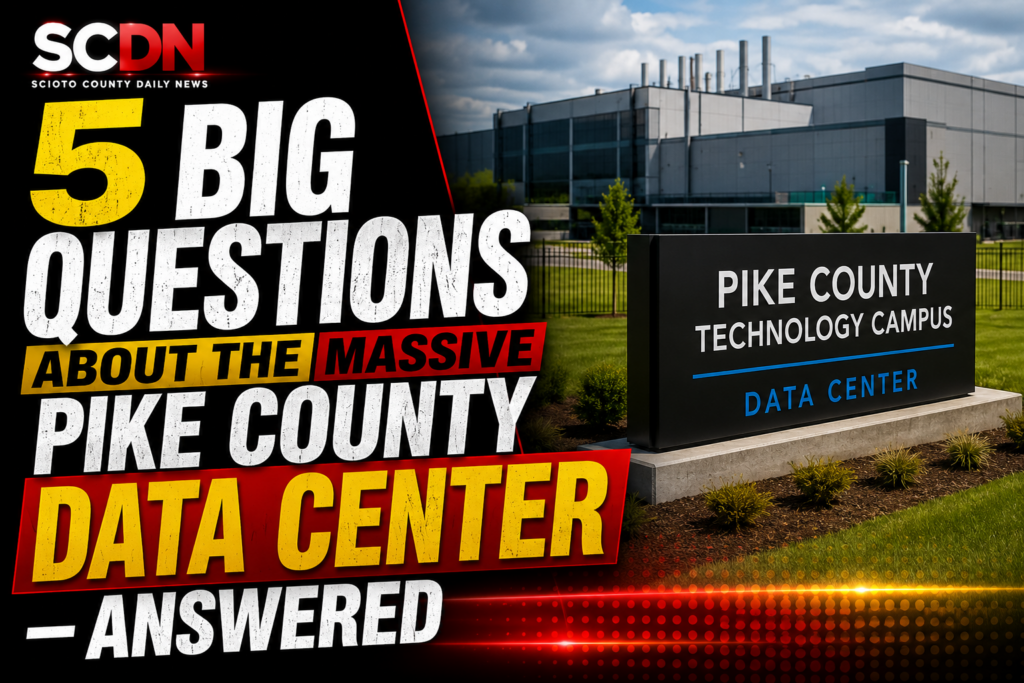
The massive data center project planned for the former Portsmouth Gaseous Diffusion Plant site in Pike County is getting a lot more real.
The company behind ChatGPT, OpenAI, has agreed to secure approximately 8 gigawatts of computing capacity at the PORTS-Pike Technology Campus. SB Energy will build, own and operate the data center, while NVIDIA technology will provide the computing power inside.
The numbers are huge: 35,000 construction jobs during the six-year buildout, 2,500 permanent jobs and billions of dollars worth of new power and infrastructure.
But those big numbers also raise some big questions, especially after months of controversy surrounding data center development across Ohio.
Here are five of the biggest.
- Will This Data Center Make My Electric Bill Go Up?
The developers say you won’t be asked to pay for the power infrastructure needed specifically for this project.
That’s an important distinction.
One of the biggest concerns about Ohio’s data center boom is the tremendous amount of electricity these facilities consume and whether residential customers will eventually be stuck paying for new transmission lines and other infrastructure needed to serve them.
For the PORTS-Pike project, SB Energy has committed to paying the full cost of the grid upgrades and new transmission lines required specifically for the development.
The announcement says those costs will not be shifted to other Ohio ratepayers.
That doesn’t mean anyone can promise your electric bill will never increase. Electricity prices are affected by many things.
What developers are promising is that Ohio residents won’t be asked to pick up the project-specific tab for connecting this massive data center to the power grid.
And massive really is the word.
The first 800 megawatts of capacity are expected to become available in 2028, largely using existing AEP infrastructure. Later phases will require new power generation, including natural gas plants, along with new transmission lines and other infrastructure.
- What About Water? Aren’t Data Centers Water Hogs?
Some are. Developers say this one is being designed to use much less.
Water consumption has become another major concern surrounding data centers, particularly facilities that use large amounts of water to keep thousands of computer servers cool.
OpenAI says PORTS-Pike will instead use a closed-loop, air-cooled system.
Think of it as recycling the cooling water instead of constantly pulling in fresh water, using it once and replacing it.
The system will initially have to be filled, but OpenAI says that after that, ongoing water use should be comparable to an office building supporting a similar number of people. Water would still be needed for things such as bathrooms, cleaning, maintenance and landscaping.
The project is also looking at using the Department of Energy’s existing water system at the former atomic plant and says it will help pay for new water infrastructure that can also benefit surrounding communities.
However, there’s still an important unanswered question:
Exactly how many gallons will it use?
The final number isn’t available yet. OpenAI says it will publicly report expected water consumption once the site design is finished and then report actual water use annually.
- Are There Really Going to Be 35,000 Jobs?
Developers are projecting 35,000 construction jobs during the six-year buildout through 2032 — not 35,000 permanent employees working there every day.
That’s an important difference.
A project of this size will require an enormous construction workforce over several years, including electricians, equipment operators, pipefitters, laborers and many other skilled trades.
Once the campus is operating, developers project approximately 2,500 long-term jobs.
OpenAI and SB Energy say they intend to prioritize local workers, contractors, suppliers, trades and service businesses.
The PORTS-Pike Campus has also signed an agreement with North America’s Building Trades Unions, and developers say they plan to work with Ohio trade unions, schools, colleges, apprenticeship programs, veterans groups and workforce organizations.
That could make the impact much larger than Pike County alone.
Thousands of Southern Ohio residents currently travel to Columbus, Cincinnati and other areas for construction work. A project of this size could potentially put years of work much closer to home while also creating opportunities for restaurants, stores, hotels, trucking companies and other local businesses.
- What Does Pike County Get Out of the Deal?
Jobs aren’t the only promised benefit. There’s also community money and tax revenue.
OpenAI says it will establish a $40 million community grant fund based on priorities identified by local residents.
That’s in addition to a previously announced $40 million community commitment from SB Energy.
Potential uses include schools, public safety, health care, utilities, workforce training, housing, veterans services, small businesses and programs for working families.
Developers also say the project is expected to generate hundreds of millions of dollars in state and local tax revenue over its lifetime, with property taxes primarily benefiting schools.
There’s also an $84 million statewide component.
OpenAI says approximately 844,000 eligible Ohio college, community college and technical school students will be offered $100 in credits to use Codex, an AI tool inside ChatGPT that can help users build software and complete technical projects.
Taken together, OpenAI says its community investments, student credits and SB Energy’s previously announced commitment represent more than $160 million in benefits for Pike County and Ohio residents.
- Is This the Same Data Center Being Built in Franklin Furnace?
No. They are completely separate projects.
That’s probably going to cause plenty of confusion because two enormous data center developments are moving forward only a relatively short distance apart.
The Franklin Furnace project in Scioto County is Google’s Project Dazzler. Construction is already underway there, and county officials recently said between 150 and 200 workers were on site, with the construction workforce potentially reaching approximately 3,500 at its peak.
The project we’re talking about here is the PORTS-Pike Technology Campus in Pike County, at and around the former Portsmouth Gaseous Diffusion Plant.
OpenAI will be a customer of this development. SB Energy will build, own and operate the data center under a 20-year lease, and the facility will use NVIDIA computing equipment.
And this project is substantially larger in its planned power requirements.
The two developments aren’t connected, but together they illustrate just how quickly Southern Ohio is becoming a center for the infrastructure needed to support artificial intelligence and cloud computing.
So What’s the Catch?
There is still a long way to go.
The entire 8-gigawatt project isn’t approved, powered and ready to build tomorrow. Later stages depend on permits, environmental reviews, financing, new power generation and major transmission construction.
That’s particularly important at PORTS, where the federal government continues dealing with the environmental legacy of the former uranium enrichment operation.
And the promises being made now still have to be kept.
OpenAI says it will publish annual reports showing local hiring, community investments, water consumption and project-related energy use. The company also says it plans to work with local residents to develop an Ohio Community Compact spelling out specific commitments.
Those reports should give Southern Ohio residents something much more useful than promises to judge the project by:
actual numbers.