













































































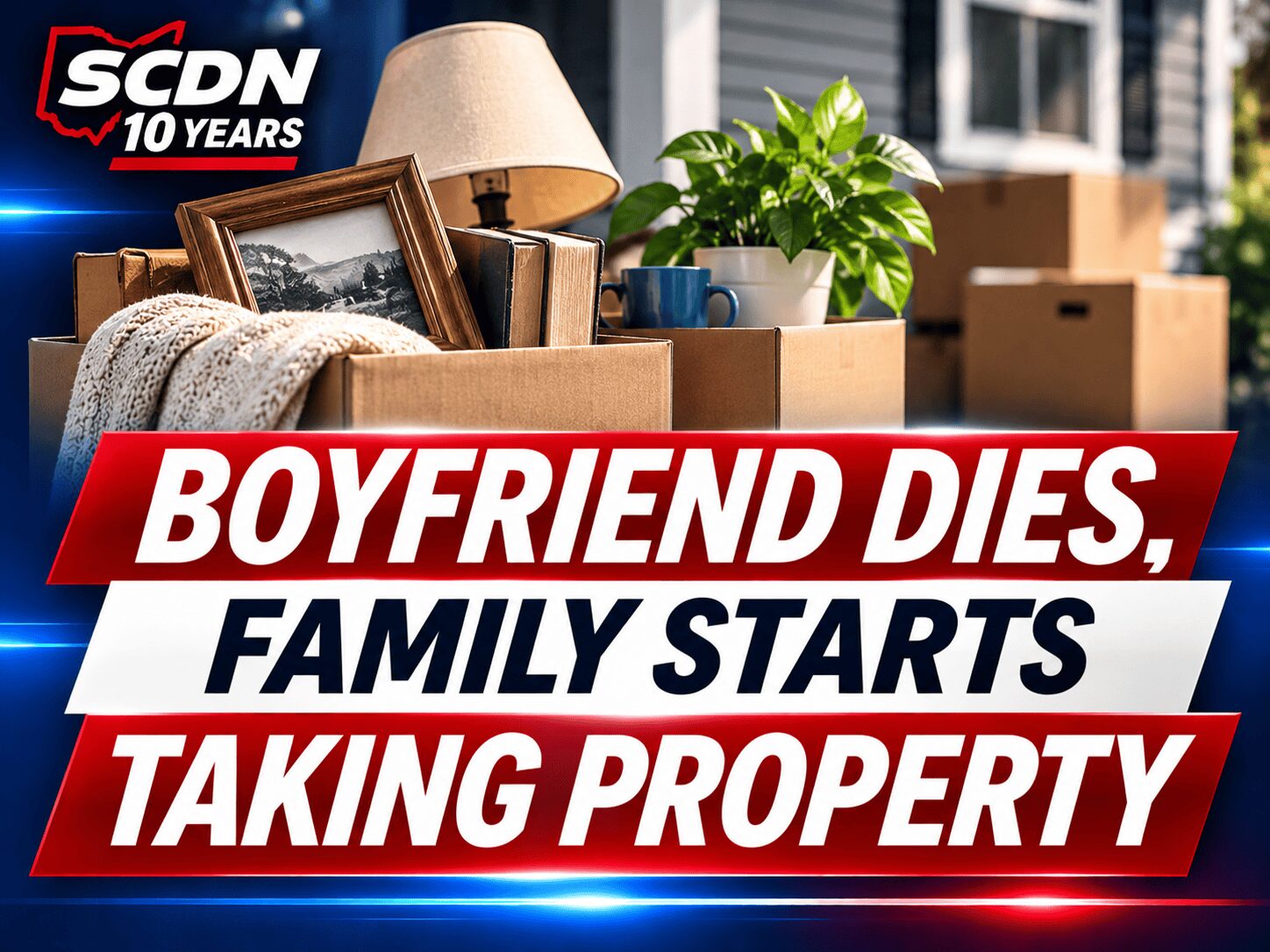
A Sciotoville woman called deputies after her longtime living situation apparently turned into a property dispute within days of her boyfriend’s death.
The woman told deputies she had been living at the home with her boyfriend, who died the previous week.
She said his daughters had begun removing belongings from the residence and were selling or getting rid of property.
The caller told dispatchers the house had not yet gone through probate.
She waited next door at the landlord’s residence while deputies responded and told authorities members of her late boyfriend’s family were still at the home taking things.
The call highlights a problem that can become complicated very quickly when an unmarried couple shares a home and one partner dies.
Living Together Does Not Make You a Spouse
In Ohio, an unmarried boyfriend or girlfriend does not automatically inherit simply because the couple lived together.
If a person dies without a will, Ohio’s intestate succession law distributes probate property to legally recognized heirs — beginning with a surviving spouse and children and then moving through other relatives.
An unmarried partner is not included in that normal line of inheritance.
That means living with someone for 10, 20 or even 30 years does not, by itself, give you the same inheritance rights as a husband or wife.
And that can be a terrible surprise at exactly the worst possible time.
So What Does Probate Do?
Probate is the court process used to sort out property owned by someone who has died.
If there is a will, the probate court determines whether it is valid and oversees the estate.
If there is no will, Ohio law determines who inherits.
The court appoints an executor or administrator, who is responsible for identifying the deceased person’s property and debts, preparing an inventory, paying legitimate debts and eventually distributing what remains to the people legally entitled to receive it.
That is why family members simply walking into a house and deciding what belongs to whom can create a mess.
Some property may belong solely to the deceased person.
Some may belong solely to the surviving partner.

Some may have been purchased jointly.
Some may already pass outside probate because of how ownership or beneficiary paperwork was set up.
Those questions generally need to be sorted out — not settled by whoever gets to the house first.
The House Can Be an Even Bigger Problem
If your name is on the deed, your ownership interest does not disappear because your partner dies.
But simply living in a house does not put your name on the deed.
And the exact wording on the deed matters.
For example, property set up with a right of survivorship can pass to the surviving co-owner without going through the ordinary probate process. Ohio Legal Help recommends checking the recorded deed to determine exactly how the property is titled.
If the deceased partner owned the home alone, the surviving unmarried partner may be in a much weaker position unless the owner made other arrangements through a will, trust, transfer-on-death designation or other estate planning.
What If You Don’t Own the House? Get Your Living Arrangement in Writing
This is where people who live with a boyfriend, girlfriend, friend or relative can protect themselves before there is a crisis.
If you are not going to be placed on the deed, get something in writing establishing that you legally live there.
That could be a lease or other written occupancy agreement.
It does not necessarily have to involve traditional monthly rent. Ohio law allows rental agreements to contain terms covering the duration of the agreement and the rights and responsibilities of the parties, so long as those terms are lawful.
A written agreement can establish things such as:
- who is allowed to live in the home;
- whether rent is paid and, if so, how much;
- who pays utilities;
- what parts of the property the resident may use;
- how long the arrangement lasts;
- what notice is required before it ends.
That piece of paper may become extremely important if the person who owns the home dies and relatives suddenly show up believing the surviving partner has no right to be there.
Keep Proof of What Belongs to You
The same principle applies to personal belongings.
If you move into someone else’s home, keep receipts for expensive items you purchase.
Photograph valuable furniture, electronics, tools, jewelry and other possessions.
Keep bank or credit-card records showing what you paid for.
For major purchases made together, write down who owns what — especially if one person paid most or all of the cost.
And keep those records somewhere you can access if you suddenly lose access to the house.
Otherwise, after a death, a simple question such as “Whose television is that?” can turn into one person’s word against another’s.
Don’t Forget Cars, Bank Accounts and Beneficiaries
A will is important, but it is only part of the picture.
Couples should also look at:
- vehicle titles;
- bank accounts;
- retirement accounts;
- life insurance beneficiaries;
- payable-on-death accounts;
- transfer-on-death designations;
- deeds and survivorship language.
Some property can pass directly to another person without becoming part of the probate estate at all.
That can make an enormous difference for an unmarried partner.
Marriage Comes With Rights That Dating Does Not
Ohio law gives surviving spouses a collection of specific probate rights that unmarried partners simply do not receive automatically.
Those can include inheritance rights and, in some circumstances, rights involving the family residence and support from the estate.
That doesn’t mean every couple needs to marry.
It means couples who choose not to marry need to do more paperwork if they want to protect each other.
A will, properly prepared deed, beneficiary designations and written living arrangement can accomplish things that years of simply sharing a home may not.
Do It Before You Need It
Nobody likes sitting down with a boyfriend or girlfriend and saying:
“What happens to me if you die?”
But that conversation is considerably easier than having it with grieving relatives standing in the living room carrying your possessions toward the door.
If you live with someone and your name is not on the deed, find out exactly what your legal status is.
Get your living arrangement in writing.
Document what belongs to you.
And if you intend your partner to inherit from you, don’t assume the law already knows that.
Put it on paper.