










































































Scioto County Commissioners say skyrocketing foster care placement costs have pushed the county toward a projected $2.5 million deficit, and they are trying to figure out how to close the gap without cutting other offices to the bone.
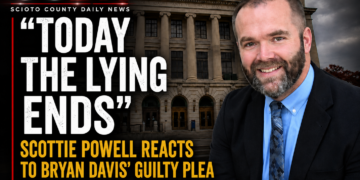
“It’s driven entirely by the cost of kids in care,” Commissioner Scottie Powell said. “What I’m working through is trying to better understand the jump.”
Powell said when the county dissolved the Children Services Board and placed Children Services under Job and Family Services, there were 407 children in care. Today, that number is just over 200.
But commissioners say caring for 200 children now costs more than caring for 400 children did just a few years ago.
Powell said placement costs can vary wildly, with some children costing $50 a day, others $100 a day, and some as much as $1,500 a day.
“There’s really no standard that quantifies what am I getting for $1,500,” Powell said. “Right now, it’s not capped.”
Powell said there had been work at the state level to create a rate card for these services, but that effort ran into resistance in Columbus. He said powerful lobbying interests are working to keep the system as it is.
“It’s not sustainable,” Powell said, noting that Lawrence and Adams counties are also facing similar problems.
Powell compared some placement costs to the cost of medical care, saying that in some cases the system is paying more per day for a child with special needs than it would cost to maintain a patient on a ventilator.
“I don’t understand,” Powell said. “Some state regulations are going to have to change.”
Commissioner Merit Smith said all three commissioners have reviewed the numbers and met with Job and Family Services to look for answers.
“They have no answer,” Smith said.
Smith said the county does receive Title IV-E federal placement money to help offset the cost of caring for children who meet certain criteria. However, he said even when paperwork is completed correctly, the federal reimbursement is slow to arrive.
“It slowly trickles in,” Smith said. “They work on their own time scale. It puts us farther and farther behind.”
Smith said the funding may cover around 60% of a child’s placement, but that still leaves the county with a major gap.
“It’s not data centers that keep me awake at night,” Smith said. “It’s coming up with the money for the placement of children, so we can safely take care of them without going broke.”
Commissioner Will Mault agreed.
“That’s the reality of it,” Mault said. “We’re doing everything we can possibly do. It keeps me awake at night.”
All three commissioners were serving on the Scioto County Children Services Board when it was dissolved and Children Services was placed under Job and Family Services.
When WNXT’s Bill Shope asked whether they regretted that decision, Powell said the move placed responsibility for Children Services directly under the commissioners. He said that, under the previous structure, commissioners were sometimes asked to provide millions of dollars in additional funding just a month or two before it was needed.

Powell said the move to JFS has brought improvements. He said the agency has come into compliance with state standards, workers have received important training, and adoption numbers have increased sharply.
“Previously it was less than ten a year,” Powell said. “I think we’re on track for 40 this year.”
He also pointed to the drop from 407 children in care to around 200 as evidence that the local system is working better in some ways.
But Powell said one major piece remains outside local control: what placement providers are charging.
“We have this other piece of the puzzle we don’t control,” Powell said. “What these companies are charging — and apparently neither does the state. They are not willing to try to control it.”
Powell said he believes local workers are doing everything they can, but without changes at the state level, the county may be forced to cut elsewhere.
“What happens if we don’t figure it out?” Powell said. “We’re going to have to cut somewhere else. There are some offices that could be working on shoestring staff come December.”